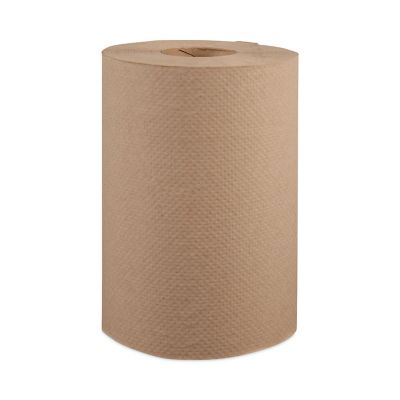
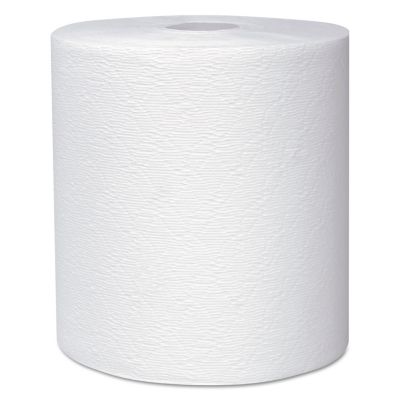
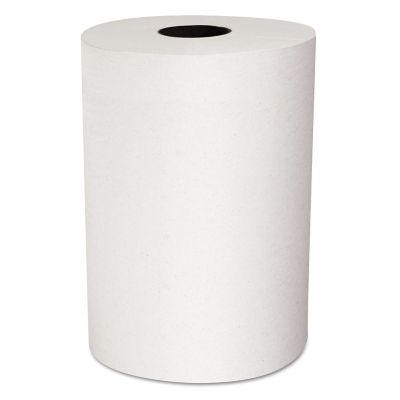
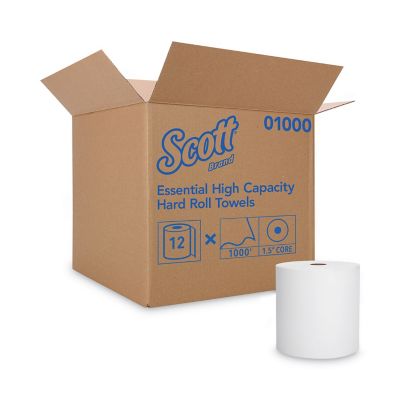
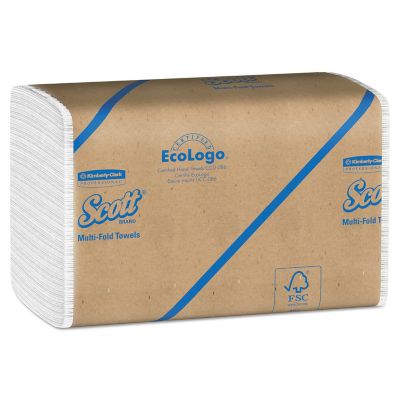
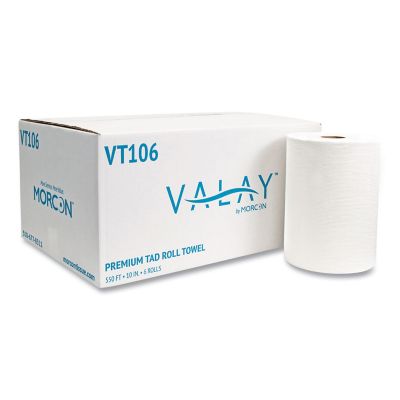
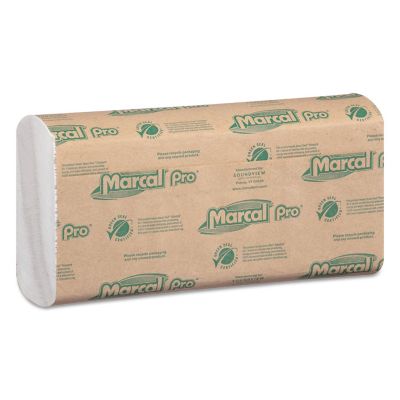
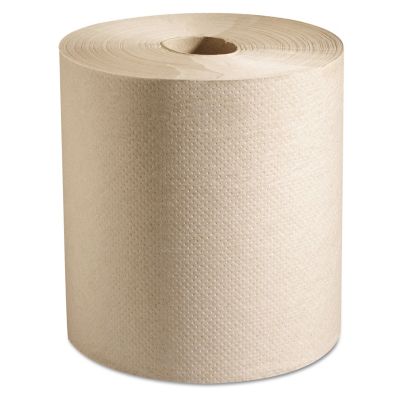
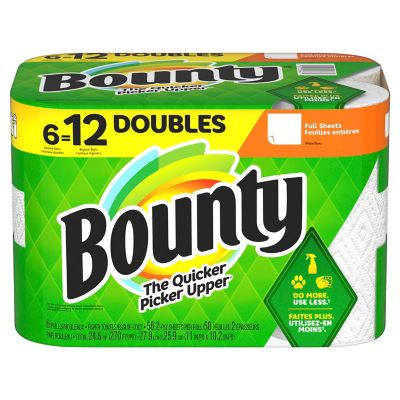
Commercial paper towel rolls keep hand-drying and everyday cleanup moving in busy restrooms, breakrooms, shops, and farm offices. Made for repeated use throughout the workday, these rolls generally hold more paper than household kitchen rolls and often fit enclosed wall-mounted dispensers. The main types are hardwound rolls, center-pull rolls, and perforated rolls for open holders. Hardwound paper towel rolls have a continuous sheet without tear lines; the dispenser measures and cuts each towel as it feeds. Many hardwound formats measure about 8 inches wide and hold roughly 350 to 1,000 feet of paper, though dimensions vary and dispenser requirements come first. Center-pull paper towel rolls dispense from the middle rather than unwinding from the outside, commonly through a nozzle that helps separate perforated sheets. Perforated standard rolls unwind from the outside and tear along preset lines, making them a familiar choice beside a breakroom sink or on a workshop towel holder. Each format serves a slightly different routine. A restroom near a livestock auction office may need long rolls that keep hand-drying stations running between service rounds, while a small repair shop may favor easy access to a few sheets for water splashes around the utility sink. School maintenance crews, restaurant operators, church caretakers, and farm employees all have reasons to keep paper towels close to sinks and routine cleanup areas. For hand-drying, a towel needs to absorb water readily and stay together long enough to finish the job. For wiping counters or catching a small spill, sheet size and wet strength matter just as much as roll length. These are everyday cleaning supplies, but the right format makes a noticeable difference when several people share a sink or a work area stays busy from opening time to the last cleanup. Matching the roll to the task helps keep towels within reach without putting an oversized dispenser where a simple holder would do.
Dispenser fit is the starting point for choosing commercial paper towel rolls. Roll width, outside diameter, core diameter, and feed style all need to match the equipment. An 8-inch-wide roll is not automatically interchangeable with every dispenser that accepts that width; a larger outside diameter may prevent the cover from closing, and the wrong core can keep the roll from turning properly. Some dispensers also require a particular core shape or drive connection. Labels such as universal can describe broad compatibility, but the dispenser’s stated specifications are still the best reference. A roll that sits correctly on its supports and follows the intended paper path is less likely to drag, bunch up, or feed unevenly. Hardwound systems may operate with a lever, a pull-to-cut mechanism, or a motion sensor, and each mechanism has its own paper requirements. Center-pull systems need rolls specifically made for center dispensing, including the correct core arrangement and sheet dimensions for the nozzle. Perforated rolls belong on holders that leave enough clearance for the full roll to turn without rubbing against a wall or shelf. For a new wash station or a replacement setup,
Industrial Paper Towel Dispensers are the other half of the match, with the cabinet and feed mechanism determining which roll formats fit. Capacity also deserves a close look. More footage can mean fewer roll changes in a busy restroom, but footage alone does not establish how many people a roll will serve. Dispensed towel length, absorbency, and the number of sheets each person takes all affect how quickly the paper runs out. In a lightly traveled office, a smaller roll may meet daily needs without requiring a larger cabinet. Around a shop sink where hands are washed repeatedly, a higher-capacity setup can reduce interruptions. Mounting location matters, too: a towel station should be easy to reach after washing without forcing people to drip water across a walkway or stretch over a workbench.
Paper composition and construction help determine how commercial towels feel and perform. Rolls may contain recycled fiber, virgin fiber, or a blend, with white and natural brown options common across commercial settings. Color alone does not establish recycled content, absorbency, or strength, so package information is a better reference than appearance. Ply describes the number of paper layers. Single-ply towels can work well for routine hand-drying and light wiping, while two-ply construction can offer a different balance of thickness, softness, and absorbency. Layer count is only part of the picture, since fiber composition, sheet weight, and embossing also influence performance. A towel that holds together when damp is helpful beside a utility sink, where someone may be drying hands after rinsing feed buckets or washing up from equipment work. A softer feel may matter more in a shared office restroom, while a larger sheet can be convenient for catching water around a breakroom coffee station. Commercial paper towels handle ordinary moisture and light messes, but they are not a substitute for shop towels or task-specific absorbents when work involves heavy grease, solvents, sharp metal shavings, or hazardous spills. Around food-preparation surfaces, paper towels can help with wiping, but the cleaning and sanitizing process still needs to follow the applicable product labels and workplace procedures. Keeping rolls in good condition is straightforward: store them in a clean, dry location, away from floor splashes, leaking containers, and airborne shop debris. Leave protective wrapping in place until a roll is ready for loading. Dispensers benefit from routine cleaning and checks for torn scraps in the feed path, with maintenance handled according to the equipment instructions. Paper towels belong in an appropriate waste container rather than a toilet, since they can clog plumbing. With a compatible roll, suitable paper construction, and sensible placement, a towel station becomes a practical part of keeping shared spaces ready for the next person and the next job.