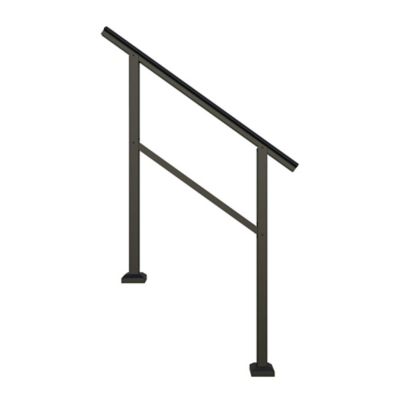
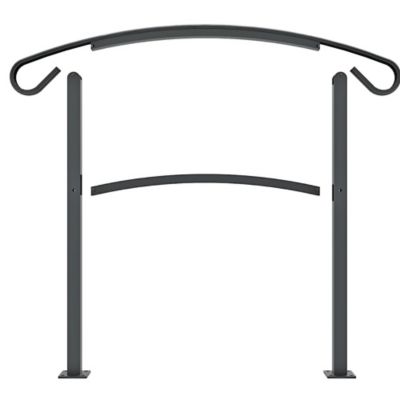
Metal rails bring support, a clear boundary, and a clean finished look to stairs, porches, decks, and walkways. Around a farmhouse, shop, or everyday entryway, the right rail gives people a steady place to hold without making the space feel closed in. Two terms matter when comparing metal railing components: a handrail provides a graspable surface for support, while a guard helps protect people from an open edge or drop. Some assemblies serve both purposes, but a broad top rail does not automatically qualify as a graspable handrail. Stair handrails commonly fall within a height range of 34 to 38 inches, measured vertically above the stair tread nosings; applicable codes and the layout of the property determine the actual requirements. Level landings, stair runs, and raised deck edges can call for different configurations, even when they sit just a few feet apart. Wall-mounted metal handrails suit stairways with a solid wall alongside them, while post-mounted rails can provide support where there is no wall. Railing panels fill the space between posts, and balusters or other approved infill help form the protective barrier. For a front porch with room for a couple of chairs, a slim metal profile can preserve sightlines across the yard. Beside a shop entrance, a straightforward rail can make a short flight of steps easier to navigate while leaving room for the door to swing. Families, property owners, and contractors often look for a consistent appearance across these connected spaces, but fit and function come before matching finishes. The shape of the gripping surface, clearance around the handrail, and the position of brackets all affect how comfortably a hand can travel along it. Rounded edges and properly finished rail ends matter, too, especially along a busy entrance where sleeves, bags, and hands pass close to the railing every day. Metal rails work best as part of a planned assembly rather than as isolated pieces chosen only by appearance.
Material makes a noticeable difference in the weight, stiffness, finish, and upkeep of metal rails. Aluminum is relatively light and naturally resistant to rust, which makes it a practical choice for many porch and deck applications. It still needs an appropriate finish and compatible hardware, and its performance depends on the rail profile, wall thickness, connections, and overall design. Steel offers substantial stiffness and suits applications where a solid feel is important, though bare carbon steel is vulnerable to corrosion. Galvanizing protects steel with a zinc layer, while powder coating forms a finished surface that adds color and a protective barrier. Neither treatment makes every assembly maintenance-free, especially where cuts, scratches, or fastener holes expose the underlying metal. Wrought iron has a long history in railings, although many railings described as iron are fabricated from steel; the material specification is a better reference than appearance alone. Stainless steel provides another option, with corrosion resistance that varies by alloy and exposure. Around a property where rails are close to cleaning chemicals, fertilizer, or other corrosive substances, material compatibility deserves extra attention. Smooth finishes are generally easier to wipe down, while more textured surfaces may hold dirt in their recesses. Black, gray, and other neutral finishes can sit comfortably alongside wood decking, concrete steps, masonry, or metal siding without drawing attention away from the building itself. A square profile tends to look crisp and substantial, while a rounded handrail offers a different feel in the palm. Neither shape establishes strength on its own; the complete assembly and its stated ratings matter more than looks. For shoppers comparing coordinated posts, rails, and connection styles,
Metal Railing Systems provides a related category to consider alongside individual rail components. Matching components within a compatible system helps avoid mismatched brackets, awkward transitions, or rail sections that cannot connect as intended. The result should feel at home on the property while meeting the demands of its location.
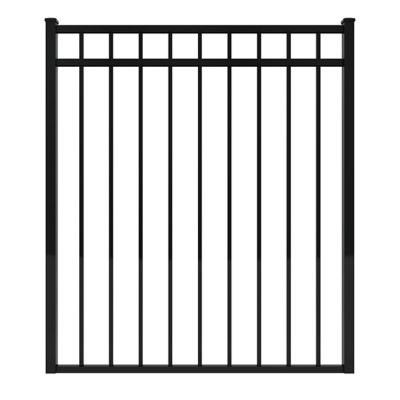
Fit involves more than finding a metal rail that is roughly the same length as a stairway or porch edge. The distance between posts, the slope of the stairs, the size of a landing, and the mounting surface all influence which configuration makes sense. A level railing section is not necessarily suitable for stairs, and an adjustable stair section has a defined angle range rather than unlimited movement. Preassembled panels can simplify layout, but their permitted span, trimming limits, and attachment details still need to match the space. Baluster spacing and openings beneath rails also matter wherever the assembly serves as a guard. For a raised porch overlooking a gravel drive, that means evaluating the whole barrier, not just the top rail. On a narrow set of entry steps, it means allowing enough usable passage space after posts and brackets are in place. Wood framing, concrete, and masonry require different anchoring approaches, and a finished deck board or thin surface layer alone may not provide the support a post needs. Appropriate structural backing, specified fasteners, and connections designed for the substrate are essential to the assembly’s performance. Published load ratings and installation requirements are more useful than judging a rail by how heavy it feels in the hand. Care is usually straightforward when it follows the finish manufacturer’s recommendations: routine cleaning with suitable products, attention to connection points, and prompt treatment of damaged finishes help preserve appearance and service life. Dirt can collect around post bases and brackets, so those spots deserve a look along with the broad, easy-to-reach surfaces. Loose fasteners, movement at a mounting point, cracking around an anchor, or visible corrosion call for assessment rather than a quick coat of paint. For homeowners and folks responsible for shared buildings, a well-fitted metal rail should offer comfortable support, sensible clearance, and a finish that suits the setting. Careful matching of materials, dimensions, and attachment requirements gives these hardworking features a place in everyday life, from the first porch step to the landing outside the shop.