

Shop Fox W1875-2 HP Benchtop Table Saw with Stand, W1875
Item # 229426899


Add this item to unlock free delivery!

Neighbor’s Club Members earn points with purchases.

Valid 9/21/2026 - 9/27/2026
Add this item to unlock free delivery!
This item is available online only
Delivery to
Free standard delivery on online footwear & Clothing purchases of $49 and over.
Neighbor’s Club Members earn points with purchases.
The W1875 Benchtop Table Saw boasts a 2 HP motor to power through your ripping, crosscutting, and miter cutting needs. The built-in folding stand offers easy portability and quick setup at job sites, and all accessories mount directly to the saw body for easy transport and storage. The extension table expands up to 27 in. W for ripping large workpieces. The handwheel performs two functions as it adjusts the blade height from 0-3-1/2 in. It rotates clockwise to raise blade; rotate counterclockwise to lower blade. Push it inward and rotate to adjust the angle blade from 0°-45°. Rotating the micro-adjustment knob finely adjusts the distance between the aluminum fence and the blade. The quick-release blade guard prevents hands and fingers from contacting the blade. Anti-kickback pawls and the spreader reduce the risk of kickback. Saw dust is diverted to and through a 2-1/2 in. dust port.The manual was written by our U.S.-based Technical Documentation Department and is packed with useful information. The complete and easy-to-read manual makes it easier to assemble and maintain your machine. The Customer Service and Technical Support Teams are also U.S.-based. Parts for this machine may be available online and shipped from the parts warehouse in Springfield, MO.
For additional information on this product, please see the Product Documents section for all downloadable user manuals, installation guides, brochures and warranty statements.
Looking for more information on tools? Check out our guide on essential woodworking power tools in the product documents section.
- Motor: 2 HP, 120-Volt
- Blade tilt: right, 0°-45°
- Table height from floor: 36-1/2 in.
- Arbor Speed: 4400 RPM
- Maximum dado width: 13/16 in.
- Maximum depth of cut: 3-1/2 in. at 90°, 2-1/2 in. at 45°
- Rip capacity: 31-1/8 in. to right, 12 in. to left
- 2-1/2 in. dust port
- Built-in folding stand for easy portability
- Quick-release blade guard
| Brand | Shop Fox |
|---|---|
| Country of Origin | Imported |
| Amperage | 20 A |
| Arbor Size | 0.625 in. |
| Blade Change Type | Keyless |
| Blade Diameter | 10 in. |
| Cord Length | 6.56 ft. |
| Cut Through | Wood |
| Dust Collection Method | 2.5 in. dust port |
| Features | Depth Adjustment;Quick Release |
| Horsepower | 2 hp |
| Housing Material | Aluminum |
| Maximum Bevel Cuts (Left) | 0 deg. |
| Maximum Bevel Cuts (Right) | 0 deg. |
| Maximum Cut Depth at 45 Degrees | 2.5 in. |
| Maximum Cut Depth at 90 Degrees | 3.5 in. |
| Maximum RPM | 4400 RPM |
| Portable or Stationary | Portable |
| Power Type | Electric |
| Product Height | 36 in. |
| Product Length | 28.5 in. |
| Product Weight | 70 lb. |
| Product Width | 57 in. |
| Rip Capacity (Left) | 12 in. |
| Rip Capacity (Right) | 31.125 in. |
| Table Height From Floor | 36.5 in. |
| Table Length | 23 in. |
| Table Width | 28.5 in. |
| Variable Speed | Single Speed |
| Voltage | 120 V |
| Warranty | 2 |
| Manufacturer Part Number | W1875 |
Q&As
Similar Items
-
Top Rated
-
-
Top Rated
-
-
-
-
-
Top Rated
-
-
-
-
Top Rated




Items You May Like
-
-
-
-
-
-
-
-
-
-
Top Rated
-
-






Reviews
Customer Images and Videos
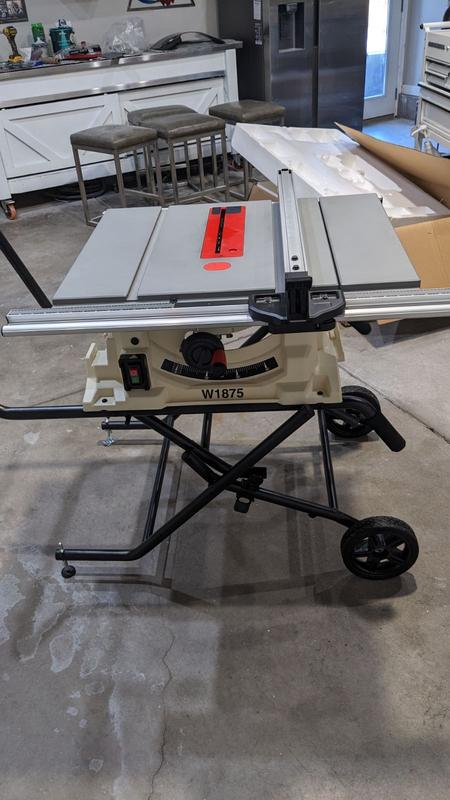
For the price should be a heavier body than plasti

Originally posted on grizzly.com
Impressive value
Yes, I recommend this product.
Originally posted on grizzly.com
Not worth the money
No, I do not recommend this product.
Originally posted on grizzly.com
Cheap and TOO LOUD
No, I do not recommend this product.
Originally posted on grizzly.com