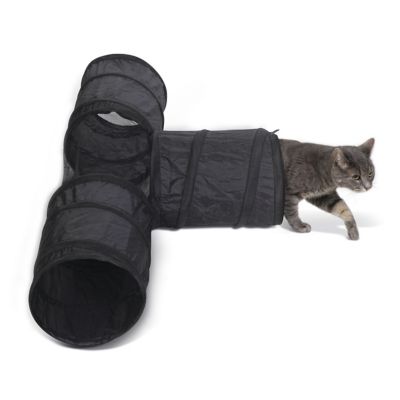
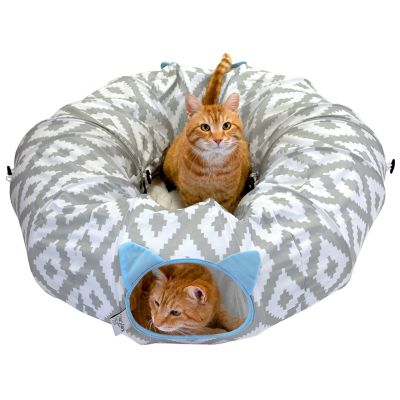
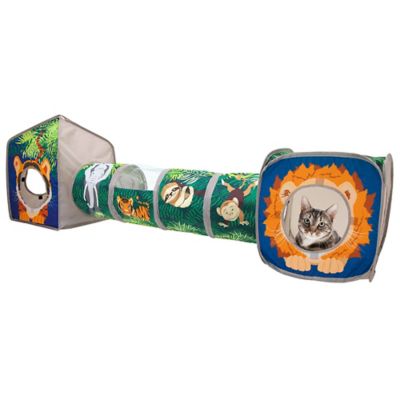
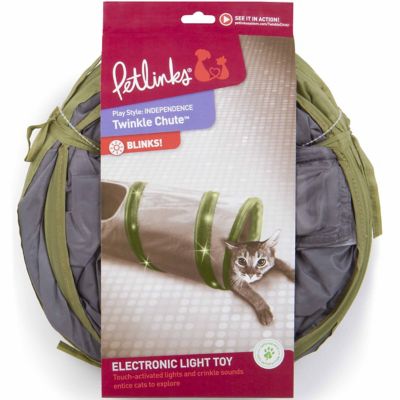
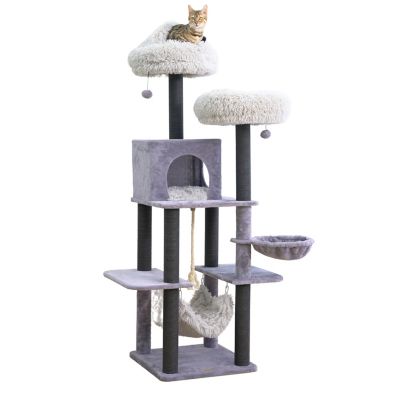
A cat tunnel for large cats gives a big house cat room to stalk, hide, stretch out, and come barreling through without squeezing into a narrow passage. For broad-chested cats, long-bodied cats, and large breeds such as Maine Coons and Ragdolls, the opening matters just as much as the overall length. An interior diameter of about 12 inches or more is a practical starting point, though some cats need additional clearance through the shoulders and belly. Many smaller tunnels measure around 9 to 10 inches across, which can make an otherwise inviting hideout a tight fit. Diameter alone does not guarantee enough room to turn around, either; that depends on the cat’s build and the tunnel’s shape. Clear interior measurements tell more about fit than an extra-large label, particularly when padded walls or a plush lining take up part of the opening. A comfortable passage lets a cat enter and back out freely, without catching fur or pressing hard against the sides. Length adds a different kind of appeal: a longer tube creates space for a low crouch and a dash toward a toy, while a shorter tunnel can serve as a tucked-away lookout beside the couch. Straight designs suit cats that enjoy charging from one end to the other, and curved or branching layouts offer more places to pause out of sight. Side openings bring in light, provide another way out, and let a cat keep an eye on the room without leaving cover. Those openings need generous dimensions, too, since a large main entrance does little good if the favorite exit is too snug. For households with two or more cats, separate entrances can help keep a playful chase moving instead of leaving one cat cornered. The best fit comes down to the individual cat, whether that means a lanky youngster with long legs or a broad adult who prefers a slow patrol followed by a nap.
Materials and construction shape how a large cat tunnel feels underfoot and how well it stands up to everyday pouncing. Polyester and nylon fabrics can make for lightweight, foldable tunnels, while canvas and other heavier woven fabrics may offer a more substantial feel. Plush or suede-like surfaces create a softer resting spot, but they can also collect shed hair and call for more frequent attention. No fabric is scratchproof, and thickness by itself does not tell the whole story. Closely woven material, neatly finished seams, and reinforced fabric around entrances and frame channels all matter when a hefty cat launches through an opening or hooks a claw into the edge. Spring-steel rings are common in collapsible tunnels because they help hold the passage open and allow it to fold for storage. A well-supported frame should return to its intended shape during ordinary play, but a tunnel is not a weight-bearing perch, and even a sturdy frame may flatten when a large cat lands on top. Fully enclosed wire and smooth edges are especially important where a cat rubs its face or slides its shoulders along the wall. The sound of the material makes a difference as well. Crinkle layers appeal to cats that enjoy rustling movement, while quieter fabric may be a better match for a cautious cat or a tunnel kept near a favorite resting spot. On smooth floors, an energetic entrance can send a lightweight tube scooting; a rug beneath the play area can help it stay put. Care requirements vary by construction, so washable fabric should not be taken to mean the entire framed tunnel can go into a washing machine. Some designs allow spot cleaning, while others have removable sections with separate washing directions. Loose hair, tracked litter, and the occasional hairball are part of life with cats, making accessible surfaces and straightforward cleaning worth considering. Thorough drying before folding helps keep moisture from lingering in the fabric. Regular checks for split seams, exposed wire, and loose attachments help catch damage before another round of play.
A roomy tunnel adds ground-level interest to a cat’s living space without requiring a tall climbing setup. It can appeal to an active indoor cat looking for something to investigate, an older cat that still enjoys watching a toy pass by, or a shy newcomer that wants a little cover while getting familiar with the household. For a cat with limited mobility, a low entrance with minimal fabric to step over can make access easier, though comfortable movement matters more than any size label. Placement often determines whether a tunnel becomes part of the daily routine. Along the edge of a room, with clear space at each exit, it offers a sheltered route without putting a cat directly in the path of boots, laundry baskets, or a swinging door. A sprawling three-way layout needs more floor space than a straight tube, particularly when every opening needs room for a big cat to step out. Collapsible construction suits homes where the play area also serves as a living room, provided folded tunnels and fastening ties are stored out of reach between sessions. During play, a wand toy moved past an entrance can give a waiting cat something to stalk without reaching hands into its hiding place. Dangling toys, feathers, and strings call for supervision, especially with cats that chew or pull pieces loose. Other
Cat Toys for Large Cats can complement a tunnel with different ways to chase, bat, and wrestle, keeping the tube itself a place for both movement and rest. There is no need to push a reluctant cat inside; leaving the openings clear and allowing an unhurried introduction gives curiosity room to work. Most fabric play tunnels are intended for indoor activity unless their care and use information says otherwise, and an open-ended tunnel is neither a carrier nor a secure enclosure. As a gift for someone with a big cat, a spacious tunnel makes the most sense when the cat’s measurements, play habits, and household floor space are known. Those everyday details help turn a simple fabric passage into a favorite ambush spot, hideaway, or quiet place to sprawl.