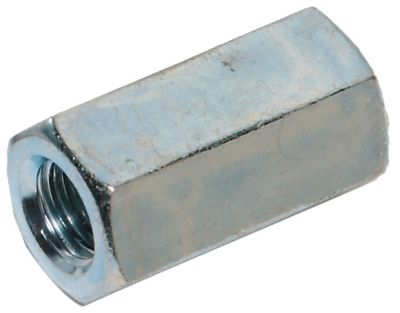
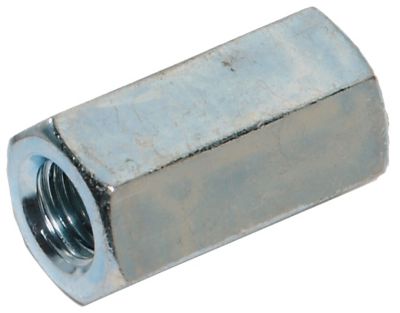
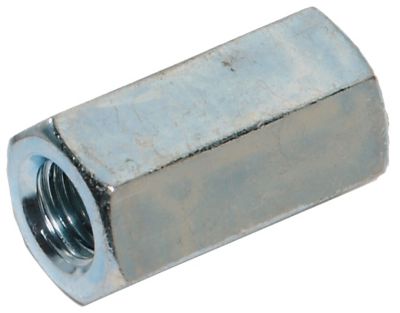
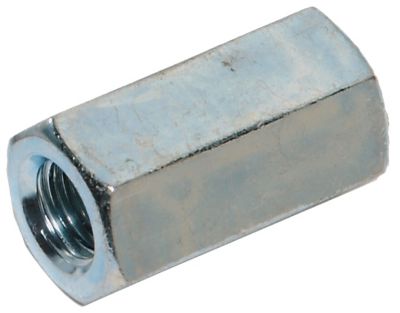
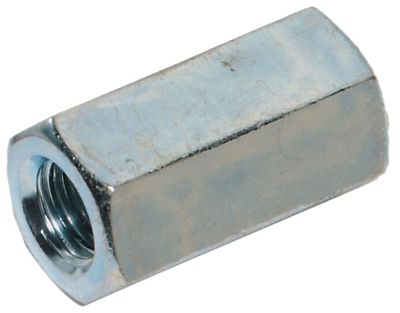
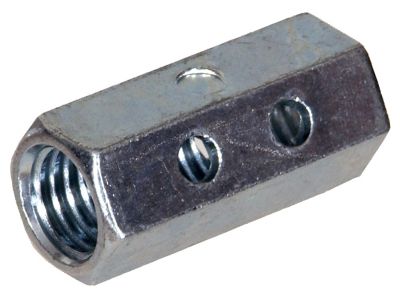
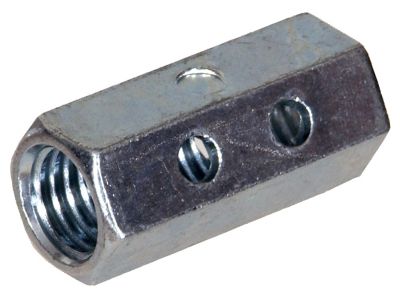
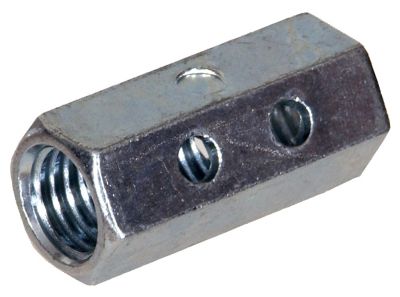
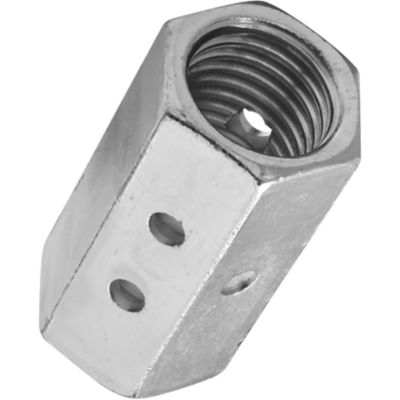
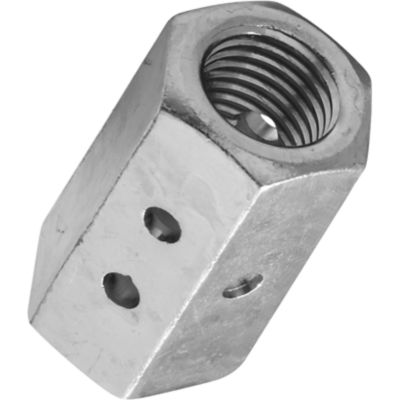
Steel coupling nuts join two externally threaded parts end to end, most often to extend threaded rod or connect a rod to a threaded stud. Their elongated bodies provide room for threads to engage from both ends, while the familiar hex shape gives a wrench flat surfaces to grip. That combination makes them practical hardware for farm shops, equipment sheds, maintenance benches, and building projects where a standard nut cannot bridge the connection. A typical application might involve extending rod for a pipe support, joining sections beneath a workbench, or connecting threaded components in an adjustable fixture. The right connection depends on more than whether the pieces screw together: thread size, engagement length, material, and load requirements all matter. Standard coupling nuts generally have the same internal thread at each end. Reducer coupling nuts connect different thread sizes, such as 3/8"-16 and 1/4"-20, when both ends match their mating parts. These fittings belong to the broader family of
Threaded Couplings, but rod couplers should not be confused with pipe fittings intended to carry liquids or gases. Most rod coupling nuts have straight machine threads, not tapered pipe threads, and they do not create a sealed plumbing joint. For farmers, mechanics, maintenance crews, and folks tackling repairs around the property, that distinction helps keep hardware matched to its job. A coupling nut can bridge two sound threaded sections, but it does not restore the strength of a cracked stud or fix damaged threads. On a bench fixture, a longer connection may simply provide the reach the assembly needs. Above a walkway or beneath a supported load, the same general hardware category calls for closer attention to documented ratings and installation requirements. Coupling nuts can also serve in purpose-built jigs and positioning assemblies, provided the design accounts for movement, vibration, and the forces traveling through the joint. Their usefulness comes from a straightforward function: connecting compatible threaded parts without requiring a single continuous rod.
Material and finish help determine where steel coupling nuts fit best and how much attention they need over time. Plain carbon steel has no protective plating, so it is better suited to protected locations or assemblies with an appropriate corrosion-control plan. Zinc-plated steel adds a protective layer that can suit many indoor installations and some lightly exposed applications, though that thin coating is not a substitute for a finish specified for more demanding exposure. Hot-dip galvanized steel carries a thicker zinc coating and often fits projects involving exposed supports or galvanized threaded hardware. That coating also affects thread fit. Galvanized coupling nuts and rods need compatible thread allowances; forcing together mismatched parts can damage the coating or prevent proper engagement. Stainless steel coupling nuts offer corrosion resistance through the alloy itself rather than a zinc surface layer. Common designations include 18-8 and 304, while 316 generally offers better resistance to chloride-related corrosion. Those labels are useful starting points, not guarantees that every stainless connection suits every chemical or setting. Around wash areas, fertilizer storage, or equipment cleaning stations, exposure conditions deserve a closer look before choosing the hardware. Strength is a separate consideration from corrosion resistance. Neither a shiny finish nor a stainless designation establishes a load rating, and a higher-strength rod does not make an underspecified coupling nut stronger. The nut’s material specification, proof load where provided, and compatibility with the mating rod are more useful than appearance alone. For projects involving galvanized brackets, painted steel frames, or mixed-metal assemblies, material compatibility also matters because contact between dissimilar metals can contribute to corrosion in the presence of moisture. Good care starts with clean threads and intact surfaces. Remove loose grit before assembly, inspect for corrosion or damaged thread crests, and replace hardware with stripped threads, cracks, or substantial pitting. Lubricants and anti-seize compounds should follow the installation specification, especially with stainless threads, which can gall during tightening. Lubrication changes friction and can affect the relationship between tightening torque and clamping force.
Fit begins with the complete thread designation, not just the apparent hole size. On an inch-series coupling nut marked 3/8"-16, the first number identifies the nominal mating thread diameter and the second gives the threads per inch. A 3/8"-24 thread has the same nominal diameter but a different pitch, so the two will not mate correctly. Metric threads follow a different designation, such as M10 × 1.5, and close-looking inch and metric parts are not interchangeable. Coarse and fine threads, right-hand and left-hand threads, and the two ends of a reducer coupling nut all deserve a check against the rod or stud. Correctly matched, clean parts should generally start by hand; resistance at the first turn is a reason to stop rather than reach for a longer wrench. Overall nut length, width across the flats, and surrounding clearance matter, too. A coupler tucked beside a frame rail needs enough room for wrench access, while a longer body may interfere with nearby brackets even when the threads match. Both rods need sufficient engagement according to the connection design and manufacturer’s requirements. Merely catching a few threads at each end does not establish a sound joint, and total nut length alone does not confirm how far each rod extends inside. Some coupling nuts incorporate an inspection opening to help verify rod position, but any engagement requirement still comes from the applicable specification. Load capacity cannot be assigned from diameter alone: nut grade, rod grade, thread engagement, load direction, vibration, and the surrounding assembly all influence performance. Suspended equipment, overhead supports, lifting applications, and structural connections call for hardware expressly rated or specified for that service. In a farm-shop fixture or equipment stand, keeping the rods aligned helps avoid bending forces that the connection may not be designed to carry. Where vibration is present, a specified locking method may also be necessary; a coupling nut by itself does not guarantee resistance to loosening. Matching the thread, finish, strength requirements, and available space makes these small connectors a practical part of a well-planned repair or assembly.