[Christmas](https://www.tractorsupply.com/tsc/catalog/christmas)[Halloween](https://www.tractorsupply.com/tsc/catalog/halloween)[Pet](https://www.tractorsupply.com/tsc/category/pet)[Lawn & Garden](https://www.tractorsupply.com/tsc/category/lawn-garden)[Truck & Automotive](https://www.tractorsupply.com/tsc/catalog/truck-automotive)[Sporting Goods](https://www.tractorsupply.com/tsc/category/sporting-goods)[Horse](https://www.tractorsupply.com/tsc/category/horse)[Farm & Ranch](https://www.tractorsupply.com/tsc/category/farm-ranch)[Clothing](https://www.tractorsupply.com/tsc/category/clothing)[Livestock](https://www.tractorsupply.com/tsc/catalog/livestock)[Pet & Animal Pharmacy](https://www.tractorsupply.com/tsc/category/pet-animal-pharmacy)[Tools](https://www.tractorsupply.com/tsc/category/tools)[Poultry](https://www.tractorsupply.com/tsc/category/poultry)[Fencing & Gates](https://www.tractorsupply.com/tsc/category/fencing-gates)[Home Improvement](https://www.tractorsupply.com/tsc/category/home-improvement)[Outdoor Living](https://www.tractorsupply.com/tsc/category/outdoor-living)[Heating & Cooling](https://www.tractorsupply.com/tsc/category/heating-cooling)[Home Decor & Furniture](https://www.tractorsupply.com/tsc/category/home-decor-furniture)[Outdoor Power Equipment](https://www.tractorsupply.com/tsc/category/outdoor-power-equipment)[Trailers & Towing](https://www.tractorsupply.com/tsc/category/trailers-towing)[Boots & Shoes](https://www.tractorsupply.com/tsc/category/boots-shoes)[Wild Birds & Wildlife](https://www.tractorsupply.com/tsc/category/wild-birds-wildlife)[Toys](https://www.tractorsupply.com/tsc/category/toys)[Gift Cards](https://www.tractorsupply.com/tsc/catalog/gift-cards-3074457345616710669-1)[Services](https://www.tractorsupply.com/tsc/services) [Propane Refill](https://www.tractorsupply.com/tsc/services/propane-refill-Franklin-TN-37069-2314)[Trailer Rental](https://www.tractorsupply.com/tsc/services/trailer-rental)[Garden Center](https://www.tractorsupply.com/tsc/services/garden-center-Franklin-TN-37069-2314)[Feed Center](https://www.tractorsupply.com/tsc/services/feed-center-Franklin-TN-37069-2314)[Same Day Delivery](https://www.tractorsupply.com/tsc/services/same-day-delivery)[PetVet Clinic](https://www.tractorsupply.com/tsc/services/petvet)[Pet Wash](https://www.tractorsupply.com/tsc/services/pet-wash)[Grooming at Petsense](https://www.tractorsupply.com/tsc/services/grooming-at-petsense)[Dog Training at Petsense](https://www.petsense.com/pages/training)[Tractor Supply Rx](https://www.tractorsupply.com/tsc/category/pet-animal-pharmacy)[Pet Insurance](https://quote.petted.com/quote/ref=tractor?cm_sp=Navi-_-Pet%20L1-_-Insurance)[Wag!](https://wagwalking.com/partners/tractor-supply?isIntSrch=written)
"Savings and Offers"
[Weekly Ad](https://www.tractorsupply.com/tsc/cms/digital-flyer)[Sale](https://www.tractorsupply.com/tsc/sale)[Clearance](https://www.tractorsupply.com/tsc/clearance)
"More Options"
[Weekly Ad](https://www.tractorsupply.com/tsc/cms/digital-flyer)[What's New](https://www.tractorsupply.com/tsc/whatsnew)[Tractor Supply App](https://www.tractorsupply.com/tsc/cms/app)[Earn Rewards with Neighbor's Club](https://www.tractorsupply.com/tsc/cms/neighbors-club)[Hometown Heroes](https://www.tractorsupply.com/tsc/myaccount/herobenefits)[Life Out Here Blog](https://www.tractorsupply.com/tsc/cms/life-out-here)[TSC Exclusive Brands](https://www.tractorsupply.com/tsc/cms/exclusive-brands)[Top Brands](https://www.tractorsupply.com/tsc/brands)[Clearance Items](https://www.tractorsupply.com/tsc/clearance)[Battery Finder](https://tractorsupply.interstatebatteries.com/?cm_sp=Header-_-Shop-_-Battery_Finder)[Outdoor Power Equipment Parts Finder](http://www.ordertree.com/tsc/?cm_sp=Header-_-Shop-_-Parts_Finder)[Hitch Finder](https://www.reesetowpower.com/tractor-supply/?cm_sp=Header-_-Shop-_-Hitch_Finder)
Spend $49.99 to unlock Free Delivery on most orders
|
[Learn More](https://www.tractorsupply.com)
[Order status](https://www.tractorsupply.com/tsc/orders?orderlookuppage)[TSC Credit Cards](https://www.tractorsupply.com/tsc/cms/credit)[What’s new](https://www.tractorsupply.com/tsc/whatsnew)[Petsense](https://www.petsense.com/)[Weekly Ad](https://www.tractorsupply.com/tsc/cms/digital-flyer)
[](https://www.tractorsupply.com)
[](https://www.tractorsupply.com/)
Grassland (Franklin) TN
GRASSLAND (FRANKLIN) TN #2314
[2176 Hillsboro RD STE 122
Franklin, TN 37069](https://www.google.com/maps/search/?api=1&query=Tractor%20Supply%20Co.%201650%20Denmark%20RD%2CUnion%2CMO%2063084)
Open until 9:00 pm
615-595-5700
Store Hours:
[Details](https://www.tractorsupply.com/tsc/store_Franklin-TN-37069_2314)
Grassland (Franklin) TN
Closed Today
Deliver to
37027
Ask ScoutAI
Sign In / EnrollGet rewarded!
Sign In / EnrollGet rewarded!
[](https://www.tractorsupply.com/tsc/cart)
Ask ScoutAI
[Christmas](https://www.tractorsupply.com/tsc/catalog/christmas)
[Halloween](https://www.tractorsupply.com/tsc/catalog/halloween)
[Pet](https://www.tractorsupply.com/tsc/category/pet)
[Lawn & Garden](https://www.tractorsupply.com/tsc/category/lawn-garden)
[Truck & Automotive](https://www.tractorsupply.com/tsc/category/truck-automotive)
[Sporting Goods](https://www.tractorsupply.com/tsc/category/sporting-goods)
[Horse](https://www.tractorsupply.com/tsc/category/horse)
[Farm & Ranch](https://www.tractorsupply.com/tsc/category/farm-ranch)
[Clothing](https://www.tractorsupply.com/tsc/category/clothing)
[Livestock](https://www.tractorsupply.com/tsc/category/livestock)
[Pet & Animal Pharmacy](https://www.tractorsupply.com/tsc/category/pet-animal-pharmacy)
[Tools](https://www.tractorsupply.com/tsc/category/tools)
[Poultry](https://www.tractorsupply.com/tsc/category/poultry)
[Fencing & Gates](https://www.tractorsupply.com/tsc/category/fencing-gates)
[Home Improvement](https://www.tractorsupply.com/tsc/category/home-improvement)
[Outdoor Living](https://www.tractorsupply.com/tsc/category/outdoor-living)
[Heating & Cooling](https://www.tractorsupply.com/tsc/category/heating-cooling)
* * *
[Menu](https://www.tractorsupply.com)
Search
[Home](https://www.tractorsupply.com/)
Sign In
[Cart](https://www.tractorsupply.com/tsc/cart)
[__Deals to start the season off right -__ Shop now>](https://www.tractorsupply.com/tsc/cms/digital-flyer)
* * *
CATEGORIES
Pets
- [Dogs](https://www.tractorsupply.com/tsc/cms/life-out-here/pet/dogs)
- [Cats](https://www.tractorsupply.com/tsc/cms/life-out-here/pet/cats)
- [All](https://www.tractorsupply.com/tsc/cms/life-out-here/pet)
The Barn
- [Horse](https://www.tractorsupply.com/tsc/cms/life-out-here/the-barn/horse)
- [Livestock](https://www.tractorsupply.com/tsc/cms/life-out-here/the-barn/livestock)
- [Goats & Sheep](https://www.tractorsupply.com/tsc/cms/life-out-here/the-barn/goats-and-sheep)
- [Pigs](https://www.tractorsupply.com/tsc/cms/life-out-here/the-barn/pigs)
- [All](https://www.tractorsupply.com/tsc/cms/life-out-here/the-barn)
The Coop
- [Start Your Flock](https://www.tractorsupply.com/tsc/cms/life-out-here/the-coop/start-your-flock)
- [Poultry Breeds](https://www.tractorsupply.com/tsc/cms/life-out-here/the-coop/poultry-breeds)
- [Coop Tips](https://www.tractorsupply.com/tsc/cms/life-out-here/the-coop/coop-tips)
- [Chick Care](https://www.tractorsupply.com/tsc/cms/life-out-here/the-coop/chick-care)
- [All](https://www.tractorsupply.com/tsc/cms/life-out-here/the-coop)
Garden
- [Gardening Tips](https://www.tractorsupply.com/tsc/cms/life-out-here/garden/gardening-tips)
- [Growing Guides](https://www.tractorsupply.com/tsc/cms/life-out-here/garden/growing-guides)
Home & Land
- [Fresh Recipes](https://www.tractorsupply.com/tsc/cms/life-out-here/garden-home-land/fresh-recipes)
- [Heating & Cooling](https://www.tractorsupply.com/tsc/cms/life-out-here/garden-home-land/heating-and-cooling)
- [Bees](https://www.tractorsupply.com/tsc/cms/life-out-here/garden-home-land/bees)
- [Lawn](https://www.tractorsupply.com/tsc/cms/life-out-here/garden-home-land/lawn)
- [Fencing](https://www.tractorsupply.com/tsc/cms/life-out-here/garden-home-land/fencing)
- [All](https://www.tractorsupply.com/tsc/cms/life-out-here/garden-home-land)
Tool Shop
- [The Garage](https://www.tractorsupply.com/tsc/cms/life-out-here/tool-shop/the-garage)
- [Tool Tips](https://www.tractorsupply.com/tsc/cms/life-out-here/tool-shop/tool-tips)
- [Stock Your Shop](https://www.tractorsupply.com/tsc/cms/life-out-here/tool-shop/stock-your-shop)
- [All](https://www.tractorsupply.com/tsc/cms/life-out-here/tool-shop)
Outdoor Life
- [Birding](https://www.tractorsupply.com/tsc/cms/life-out-here/outdoor-life/birding)
- [Recreation](https://www.tractorsupply.com/tsc/cms/life-out-here/outdoor-life/recreation)
- [Hunting](https://www.tractorsupply.com/tsc/cms/life-out-here/outdoor-life/hunting)
- [All](https://www.tractorsupply.com/tsc/cms/life-out-here/outdoor-life)
1. [Home](https://www.tractorsupply.com/tsc/cms/life-out-here)
2. [Insights Surveys](https://www.tractorsupply.com/tsc/cms/life-out-here/insights-surveys)
3. The Outdoor Happiness Report
# The Outdoor Happiness Report
Apr 9, 2026[](https://www.tractorsupply.com)
To understand how outdoor activities impact mental well-being, Tractor Supply surveyed over 1,000 Americans. The study explores how much time people spend outdoors, focusing on outdoor activities such as gardening, walking, and simply relaxing outside. How does outdoor living influence stress levels, happiness, and overall quality of life, and how does this vary based on generation and region? We've unearthed some happiness-boosting tips from our findings, so stay tuned!
## Key Findings
- Monthly, the average American spends 109% more time glued to their phone than taking a stroll outside. And if you’re Gen Z? That number jumps to 134%.
- Americans are only clocking about 10 hours a week in the great outdoors.
- Grab your trowels! Gardening ranked #1 for happiness amongst outdoor hobbies.
- Feeling blue? Just add five hours of outdoor time a month and bam! You could see a 43% happiness boost.
- Green thumbs rejoice! Americans with landscaped lawns are 25% happier than those without outdoor space.
- Iowa residents spend the most time outdoors, followed by those in Ohio, Wisconsin, Oregon and Indiana.
## Americans' Outdoor Habits
First off, let's take a look at how Americans are spending their time outdoors each month, with a focus on the most popular activities. We'll also compare that to screen time, highlighting the generational differences in outdoor habits and digital engagement.

### Green Time vs. Screen Time
Our study revealed that while Americans dedicate an average of 44 hours monthly to outdoor activities, they still spend significantly more time indoors, glued to their screens. The average American spends a staggering 109% more time on their phones than taking outdoor walks each month, a figure that jumps to 134% for Gen Z. Furthermore, we found that those spending over 40 hours a week on their phones are 21% more likely to report higher stress levels compared to those spending less than 10 hours. This trend of increased screen time, particularly among younger generations, raises potential mental health concerns.
The generational divide is clear: Baby boomers lead the pack with an average of 49 hours spent outdoors monthly, while younger generations like Gen Z spend approximately 5 hours less. This means younger folks are missing out on the benefits of outdoor time.
### What are the Most Popular Outdoor Activities?
Considering the average adult has roughly 310 hours of free time each month outside of work and sleep, there's ample opportunity to pick up a new hobby and get outdoors. [Gardening](https://www.tractorsupply.com/tsc/catalog/lawn-care), for example, is a popular choice among parents, who are 16% more likely to engage in it than non-parents. Growing your food not only gets you outside more, it also provides a practical way to combat rising grocery costs, while fostering a deeper connection with nature and your backyard.
We also observed some interesting gender-based trends in outdoor hobbies. Women are about 41% more likely to grab a [trowel](https://www.tractorsupply.com/tsc/search/trowels) and start gardening – maybe it's that nurturing spirit or just a love for [fresh blooms](https://www.tractorsupply.com/tsc/catalog/plants-flowers). Meanwhile, men prefer [fishing](https://www.tractorsupply.com/tsc/catalog/fishing-rods) and are 125% more likely to spend their free time [casting lines](https://www.tractorsupply.com/tsc/catalog/baits-lures) than women. After a long day, you'd think everyone would want to sit and enjoy the fresh air, but surprisingly, less than half of men (47%) surveyed regularly relax sitting outside.
### Which States Spend The Most Time Outside?
From boosting happiness to relieving stress, outdoor activities offer a range of benefits. Time spent in green spaces has even been linked to better physical health and lower mortality rates.
In some states, Americans are more likely to embrace the outdoors—whether by visiting local parks, hiking, walking, gardening, or observing wildlife.
To determine which states spend the most time outside, Tractor Supply Company compared 32 states across 10 key metrics.
### Top 3 Most Outdoorsy States
1. __Iowa__
__Score:__ 100 out of 100
Iowa has the:
- Highest percentage of residents who visit green spaces weekly or monthly (90%).
- Highest percentage of residents who spend time watching wildlife (50%).
- Second highest percentage of residents who frequently take walks outside (90%).
- Second highest percentage of residents who bike (40%).
2. __Ohio__
__Score:__ 84.07 out of 100
Ohio has the:
- Fourth highest percentage of residents who spend time watching wildlife (41.5%).
- Fourth highest percentage of residents who swim (39%).
- Fifth highest percentage of residents who hike (48.8%).
- Seventh highest percentage of residents who frequently visit local green spaces (75.6%).
3. __Wisconsin__
__Score:__ 72.75 out of 100
Wisconsin has the:
- Second highest percentage of residents who hike (55%).
- Second highest percentage of residents who spend time watching wildlife (45%).
- Second highest percentage of residents who bike (40%).
- Seventh highest percentage of residents who run (25%).


❮ ❯

❮ ❯
## The Power of the Outdoors: Benefits for Body and Mind
Spending time outdoors offers more than just physical health benefits; it can significantly enhance happiness and reduce stress. The following data illustrates how outdoor habits and access to outdoor spaces, including [well-maintained lawns](https://www.tractorsupply.com/tsc/catalog/lawn-care), influence overall well-being in the U.S.
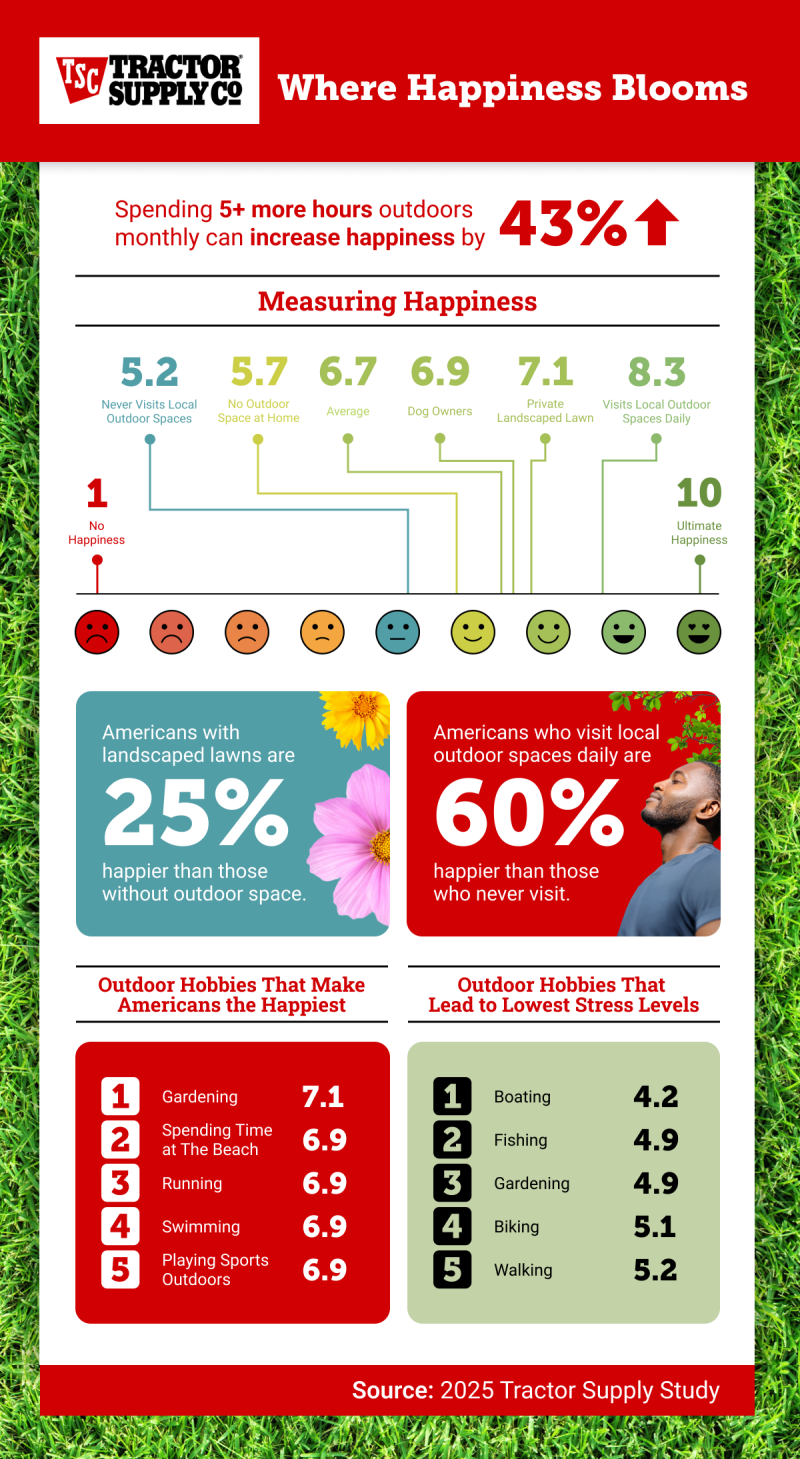
Spending at least five more hours outdoors each month can significantly impact your well-being by boosting happiness by as much as 43%. Small changes can make a dramatic impact, whether taking a walk, playing catch, or simply sitting in your backyard. Americans who visit local outdoor spaces daily are 60% happier than those who never go, and those with landscaped lawns are 25% happier than those with no outdoor space at home.
### Time Outdoors Positively Correlates with Increased Happiness
On a scale of 1 (no happiness) to 10 (ultimate happiness), Americans who never visit local outdoor spaces rate themselves at 5.2. Compare that to those with private [landscaped lawns](https://www.tractorsupply.com/tsc/catalog/lawn-mowers) (7.1) or people who visit outdoor spaces daily (8.3), and the difference is clear: touching grass boosts happiness. What else boosts happiness? Dog owners report higher happiness than the national average of 6.7, which shows that a furry friend can increase well-being and time outdoors.
### Outdoor Hobbies That Make Us the Happiest
It's not just about where you are. It's also about what you do. [Gardening](https://www.tractorsupply.com/tsc/cms/life-out-here/garden/gardening-tips) ranks as the #1 outdoor hobby for increasing happiness, scoring a 7.1 out of 10. Not only does it connect you with nature, but it also gives you a sense of accomplishment and calm. Want to get started? Try planting native flowers to attract pollinators, aerating your soil for healthier grass, or growing a small herb patch for a satisfying (and tasty) project. A few minutes spent tending to your lawn daily can become a relaxing ritual that boosts your mood. Want more tips? Check out our [how-to garden guide](https://www.tractorsupply.com/tsc/cms/life-out-here/garden-home-land/gardening/how-to-garden-guide) for easy ways to dig in.
If you have a lawn, you've already got a start. Use it as a space to unwind or get moving. Whether that's yoga on the lawn, tossing a ball around, or just soaking up the sun, a well-kept lawn doesn't just look but doesn't support mental wellness. Need to give yours a boost? Explore our range of [lawn tools](https://www.tractorsupply.com/tsc/catalog/lawn-tools) and [lawn mowers](https://www.tractorsupply.com/tsc/catalog/lawn-mowers) to help maintain a happy, healthy outdoor space.
Are you looking to get outside more often? Start by taking things you usually do indoors, like phone calls, reading, or stretching, and start doing them outside. And when it comes to exercise, doing it outdoors can bump your happiness by another 6%, thanks to the combo of endorphins and fresh air.
## What’s Keeping Us Inside? The Top Barriers to Outdoor Time
We've seen how beneficial spending time outdoors can be, but we also recognize that many Americans encounter obstacles that keep them from incorporating it into their daily lives. Unpredictable weather and the daily grind can make it tough to get outside, affecting how folks are feeling.

For many Americans, getting outdoors isn't as easy as it seems. Over half of Americans without private outdoor space visit parks monthly or less. So, what's standing in the way?
### The Biggest Barriers to More Outdoor Time in the U.S.
The most common barrier is weather, with 59% saying it keeps them indoors. Next is lack of time (43%) and work obligations (34%). Interestingly, 17% express concerns about insects and pests. If bug bites are a deterrent, there are easy [pest control](https://www.tractorsupply.com/tsc/catalog/lawn-garden-insect-control) solutions to help you reclaim your outdoor enjoyment.
Companionship is another often-overlooked factor. 28% of Americans say they'd spend more time outside if they had someone to do it with. This rises to an astounding 40% for Gen Z. You don't need a buddy to benefit from time outdoors. Whether walking your [dog](https://www.tractorsupply.com/tsc/catalog/dog-food), reading on a bench, or planting flowers on your lawn, solo time outside still offers serious mood-boosting effects. And who knows? Visiting local parks or outdoor markets is the casual setting where new friendships naturally spark.
### What is a “Third Space”?
Here's where the idea of a "third space" becomes powerful. Traditionally, your “third space” is outside the home (first) and work (second), where you feel comfortable, connected, and like you belong. For some, that's a coffee shop or a gym, but choosing an outdoor “third space", like a local park, hiking trail, or community garden, comes with extra mental health benefits. A growing body of research even shows that touching grass can make you happier, thanks to the grounding and calming effects of nature.
### Many Americans Report Dissatisfaction with Access to Local Outdoor Spaces
And yet, only two in three Americans say they're satisfied with their access to local parks and outdoor spaces. That dissatisfaction is more than a minor inconvenience. People who aren't happy with their outdoor space options report 33% more stress than those who are.
If that's you, it might be time to explore what's nearby or how you use the spaces you have. Even a short stroll through a local trail or a quiet moment on your porch can become part of your routine and your new favorite “third space”.
## Why the Outdoors Deserve a Bigger Place in Our Lives
Time spent outside matters a lot. From reducing stress and boosting happiness to creating space for connection and community, the benefits of outdoor living are too significant to ignore. While barriers like weather, companionship and pests can get in the way, there are simple, meaningful ways to reclaim outdoor time. Whether turning your lawn into a mini oasis, finding your local "third space," or just taking your everyday routine outside. With the right tools and a little intention, the outdoors isn't just a place to pass through. It's a place to thrive.
### Methodology
To explore the relationship between happiness and spending time outdoors, we surveyed 1,004 Americans. This sample size provides a 95 percent confidence level with a low 3 percent margin of error. Because this exploratory research relied on self-reported data, respondents may have biases, and discrepancies may exist between their answers and their actual experiences.
To determine which states spend the most time outside, Tractor Supply Company analyzed survey responses to compare the 32 states with available data across the following 10 metrics:
- __Percentage of residents who frequently visit local green spaces:__ 11% of score. This metric reflects the percentage of residents who visit green spaces weekly or monthly.
- __Percentage of residents who hike:__ 11% of score.
- __Percentage of residents who take walks outside:__ 11% of score.
- __Percentage of residents who garden:__ 11% of score.
- __Percentage of residents who watch wildlife outside:__ 11% of score.
- __Percentage of residents who spend time sitting outside:__ 11% of score.
- __Percentage of residents who bike:__ 11% of score.
- __Percentage of residents who swim:__ 11% of score.
- __Percentage of residents who run:__ 7% of score.
- __Percentage of residents who do outdoor photography:__ 5% of score.
### Fair Use Statement
Want to share the importance of spending more time outdoors? Feel free to share the information from this study, all we ask is that you credit Tractor Supply for the data by linking back to this page.
Get the top deals, latest trends and more
Sign up for emails from Tractor Supply today.
First Name*
First Name*
Last Name*
Last Name*
Email*
Email*
Sign Up
### Customer Support
- [Order Status](https://www.tractorsupply.com/tsc/orders?orderlookuppage)
- [Return Policy](https://www.tractorsupply.com/tsc/customer-solutions#ProductReturns)
- [Delivery Options](https://www.tractorsupply.com/tsc/customer-solutions#DeliveryOptions)
- [Tax Exemptions](https://www.tractorsupply.com/tsc/cms/policies-information/customer-solutions/tax-exemption)
- [Frequently Asked Questions](https://www.tractorsupply.com/tsc/customer-solutions#CustomerFAQ)
- [Contact Us](https://www.tractorsupply.com/tsc/customer-solutions#contact)
- [Recall Notices](https://www.tractorsupply.com/tsc/cms/policies-information/customer-solutions/recall-notices.html)
- Call:
(877) 718-6750
- [](https://www.tractorsupply.com)
Mon - Sat: 7am - 9pm CT
- [](https://www.tractorsupply.com)
Sun: 8am - 7pm CT
- [](https://www.tractorsupply.com)
Closed Christmas Day
### About Us
- [Who We Are](https://corporate.tractorsupply.com/company-overview/company-profile/default.aspx)
- [Investor Relations](https://ir.tractorsupply.com/CorporateProfile)
- [Stewardship](https://corporate.tractorsupply.com/stewardship/overview/default.aspx)
- [Community](https://ir.tractorsupply.com/Peer)
- [Military Support](https://www.tractorsupply.com/tsc/cms/military)
- [Product Catalog](https://www.tractorsupply.com/a/pt/index)
- [Tractor Supply Stores](https://www.tractorsupply.com/tsc/store-locator)
- [.Pharmacy Verified Website](https://tractorsupply.com/tsc/cms/accreditation)
### Work With Us
- [Careers](https://www.tractorsupply.careers/?utm_source=corpsite&utm_campaign=TSC_Shop&cm_sp=footer-_-tsc%20careers)
- [Sponsorship](https://www.tractorsupply.com/tsc/cms/policies-information/about-tsc/sponsorships)
- [Affiliate Program](https://www.tractorsupply.com/tsc/cms/policies-information/affiliate-program)
- [Potential Vendor Partners](https://www.tractorsupply.com/tsc/cms/policies-information/vendor-information/potential-vendor-partners)
- [Vendor Information](https://www.tractorsupply.com/tsc/cms/policies-information/vendor-information/vendor-center)
- [Tractor Supply Media Network](https://www.tractorsupplymedianetwork.com/)
### Neighbor's Club
- [About](https://www.tractorsupply.com/tsc/cms/neighbors-club)
- [Rewards](https://www.tractorsupply.com/AccountDashboardView?catalogId=10051&langId=&storeId=10151&topNav=nCOfferReward%3Fcm_sp%3Dfooter-_-navigation-_-Neighbors%20Club%20Member)
- [Hometown Heroes](https://www.tractorsupply.com/tsc/myaccount/herobenefits)
- [Frequently Asked Questions](https://www.tractorsupply.com/tsc/cms/neighbors-club-faq)
- [Terms & Conditions](https://www.tractorsupply.com/tsc/cms/neighbors-club-terms-and-conditions)
### Credit Center
- [TSC Credit Card](https://www.tractorsupply.com/tsc/cms/credit)
- [Klarna](https://www.tractorsupply.com/tsc/cms/klarna)
### Stay Connected
Connect & Share with the Tractor Supply Community.
- [](https://www.facebook.com/TractorSupplyCo?cm_sp=footer-_-social%20icons-_-facebook)
- [](https://www.pinterest.com/tractorsupplyco?cm_sp=footer-_-social%20icons-_-pinterest)
- [](https://instagram.com/tractorsupply?cm_sp=footer-_-social%20icons-_-instagram)
- [](https://www.youtube.com/user/TSCTractorSupply?cm_sp=footer-_-social%20icons-_-youtube)
- [](https://www.tiktok.com/@tractorsupply?cm_sp=footer-_-social%20icons-_-tiktok)
### Tractor Supply App
Shop on the go with the Tractor Supply App
[Learn More](https://www.tractorsupply.com/tsc/cms/app.html)
[](https://apps.apple.com/us/app/id1502197298)
[](https://play.google.com/store/apps/details?id=com.consumerapp_v1)
### Stay Connected
Connect & Share with the Tractor Supply Community.
- [](https://www.facebook.com/TractorSupplyCo?cm_sp=footer-_-social%20icons-_-facebook)
- [](https://www.pinterest.com/tractorsupplyco?cm_sp=footer-_-social%20icons-_-pinterest)
- [](https://instagram.com/tractorsupply?cm_sp=footer-_-social%20icons-_-instagram)
- [](https://www.youtube.com/user/TSCTractorSupply?cm_sp=footer-_-social%20icons-_-youtube)
- [](https://www.tiktok.com/@tractorsupply?cm_sp=footer-_-social%20icons-_-tiktok)
### Tractor Supply App
Shop on the go with the Tractor Supply App
[Learn More](https://www.tractorsupply.com/tsc/cms/app.html)
[](https://apps.apple.com/us/app/id1502197298)
[](https://play.google.com/store/apps/details?id=com.consumerapp_v1)
### Customer Support
- [Order Status](https://www.tractorsupply.com/tsc/orders?orderlookuppage)
- [Return Policy](https://www.tractorsupply.com/tsc/customer-solutions#ProductReturns)
- [Delivery Options](https://www.tractorsupply.com/tsc/customer-solutions#DeliveryOptions)
- [Tax Exemptions](https://www.tractorsupply.com/tsc/cms/policies-information/customer-solutions/tax-exemption)
- [Frequently Asked Questions](https://www.tractorsupply.com/tsc/customer-solutions#CustomerFAQ)
- [Contact Us](https://www.tractorsupply.com/tsc/customer-solutions#contact)
- [Recall Notices](https://www.tractorsupply.com/tsc/cms/policies-information/customer-solutions/recall-notices.html)
- [Call:](https://www.tractorsupply.com) [(877) 718-6750](tel:%28877%29%20718-6750)
- [](https://www.tractorsupply.com)
Mon - Sat: 7am - 9pm CT
- [](https://www.tractorsupply.com)
Sun: 8am - 7pm CT
- [](https://www.tractorsupply.com)
Closed Christmas Day
### About Us
- [Who We Are](https://corporate.tractorsupply.com/company-overview/company-profile/default.aspx)
- [Investor Relations](https://ir.tractorsupply.com/CorporateProfile)
- [Stewardship](https://corporate.tractorsupply.com/stewardship/overview/default.aspx)
- [Community](https://ir.tractorsupply.com/Peer)
- [Military Support](https://www.tractorsupply.com/tsc/cms/military)
- [Product Catalog](https://www.tractorsupply.com/a/pt/index)
- [Tractor Supply Stores](https://www.tractorsupply.com/tsc/store-locator)
- [.Pharmacy Verified Website](https://tractorsupply.com/tsc/cms/accreditation)
### Work With Us
- [Careers](https://www.tractorsupply.careers/?utm_source=corpsite&utm_campaign=TSC_Shop&cm_sp=footer-_-tsc%20careers)
- [Sponsorship](https://www.tractorsupply.com/tsc/cms/policies-information/about-tsc/sponsorships)
- [Affiliate Program](https://www.tractorsupply.com/tsc/cms/policies-information/affiliate-program)
- [Potential Vendor Partners](https://www.tractorsupply.com/tsc/cms/policies-information/vendor-information/potential-vendor-partners)
- [Vendor Information](https://www.tractorsupply.com/tsc/cms/policies-information/vendor-information/vendor-center)
- [Tractor Supply Media Network](https://www.tractorsupplymedianetwork.com/)
### Neighbor's Club
- [About](https://www.tractorsupply.com/tsc/cms/neighbors-club)
- [Rewards](https://www.tractorsupply.com/AccountDashboardView?catalogId=10051&langId=&storeId=10151&topNav=nCOfferReward%3Fcm_sp%3Dfooter-_-navigation-_-Neighbors%20Club%20Member)
- [Hometown Heroes](https://www.tractorsupply.com/tsc/myaccount/herobenefits)
- [Frequently Asked Questions](https://www.tractorsupply.com/tsc/cms/neighbors-club-faq)
- [Terms & Conditions](https://www.tractorsupply.com/tsc/cms/neighbors-club-terms-and-conditions)
### Credit Center
- [TSC Credit Card](https://www.tractorsupply.com/tsc/cms/credit)
- [Klarna](https://www.tractorsupply.com/tsc/cms/klarna)
### Stay Connected
Connect & Share with the Tractor Supply Community.
- [](https://www.facebook.com/TractorSupplyCo?cm_sp=footer-_-social%20icons-_-facebook)
- [](https://www.pinterest.com/tractorsupplyco?cm_sp=footer-_-social%20icons-_-pinterest)
- [](https://instagram.com/tractorsupply?cm_sp=footer-_-social%20icons-_-instagram)
- [](https://www.youtube.com/user/TSCTractorSupply?cm_sp=footer-_-social%20icons-_-youtube)
- [](https://www.tiktok.com/@tractorsupply?cm_sp=footer-_-social%20icons-_-tiktok)
### Tractor Supply App
Shop on the go with the Tractor Supply App
[Learn More](https://www.tractorsupply.com/tsc/cms/app.html)
- [](https://apps.apple.com/us/app/id1502197298)
- [](https://play.google.com/store/apps/details?id=com.consumerapp_v1)
- [Privacy policy](https://www.tractorsupply.com/tsc/cms/policies-information/customer-solutions/privacy-policy.html)
- [Your Privacy Choices](#)
- [Terms and Conditions](https://www.tractorsupply.com/tsc/cms/policies-information/customer-solutions/terms-and-conditions-of-use.html)
- [California Transparency Act](https://www.tractorsupply.com/tsc/cms/policies-information/about-tsc/california-transparency-act-of-2010.html)
- [Legal Notices](https://www.tractorsupply.com/tsc/cms/policies-information/customer-solutions/legal-notices.html)
- [Accessibility](https://www.tractorsupply.com/tsc/cms/accessibility.html)
- [Responsible Disclosure Statement](https://www.tractorsupply.com/tsc/cms/policies-information/customer-solutions/responsible-disclosure-statement.html)
- [Surprise (Balance) Medical Billing Disclosure](https://www.tractorsupply.com/tsc/cms/surprise-billing)
- [Transparency in Coverage](https://transparency-in-coverage.uhc.com/?cm_sp=footer-_-navigation-_-transparency%20coverage)
- [Human Rights Policy](https://www.tractorsupply.com/tsc/cms/human-rights-policy)
- [Vendor Code of Conduct](https://www.tractorsupply.com/tsc/cms/vendor-code-of-conduct)
- [California Notice of Collection](https://www.tractorsupply.com/tsc/cms/policies-information/customer-solutions/privacy-policy#_Toc189006423)
- [Privacy Requests](https://privacyportal.tractorsupply.com/)
© 2026, Tractor Supply Co. All Rights Reserved.
ScoutAI
BETA
* * *
Hi there, I’m your AI assistant—here to guide you through our products and answer any questions along the way. How can I help you?
Can you suggest some good lawn mowers ?
What’s the best safe for keeping my firearms secure at home?
What can i feed my puppy ?
* * *
TSC AI is for informational use only. Don’t share sensitive info like SSN or payment details.