[Christmas](https://www.tractorsupply.com/tsc/catalog/christmas)[Halloween](https://www.tractorsupply.com/tsc/catalog/halloween)[Pet](https://www.tractorsupply.com/tsc/category/pet)[Lawn & Garden](https://www.tractorsupply.com/tsc/category/lawn-garden)[Truck & Automotive](https://www.tractorsupply.com/tsc/catalog/truck-automotive)[Sporting Goods](https://www.tractorsupply.com/tsc/category/sporting-goods)[Horse](https://www.tractorsupply.com/tsc/category/horse)[Farm & Ranch](https://www.tractorsupply.com/tsc/category/farm-ranch)[Clothing](https://www.tractorsupply.com/tsc/category/clothing)[Livestock](https://www.tractorsupply.com/tsc/catalog/livestock)[Pet & Animal Pharmacy](https://www.tractorsupply.com/tsc/category/pet-animal-pharmacy)[Tools](https://www.tractorsupply.com/tsc/category/tools)[Poultry](https://www.tractorsupply.com/tsc/category/poultry)[Fencing & Gates](https://www.tractorsupply.com/tsc/category/fencing-gates)[Home Improvement](https://www.tractorsupply.com/tsc/category/home-improvement)[Outdoor Living](https://www.tractorsupply.com/tsc/category/outdoor-living)[Heating & Cooling](https://www.tractorsupply.com/tsc/category/heating-cooling)[Home Decor & Furniture](https://www.tractorsupply.com/tsc/category/home-decor-furniture)[Outdoor Power Equipment](https://www.tractorsupply.com/tsc/category/outdoor-power-equipment)[Trailers & Towing](https://www.tractorsupply.com/tsc/category/trailers-towing)[Boots & Shoes](https://www.tractorsupply.com/tsc/category/boots-shoes)[Wild Birds & Wildlife](https://www.tractorsupply.com/tsc/category/wild-birds-wildlife)[Toys](https://www.tractorsupply.com/tsc/category/toys)[Gift Cards](https://www.tractorsupply.com/tsc/catalog/gift-cards-3074457345616710669-1)[Services](https://www.tractorsupply.com/tsc/services) [Propane Refill](https://www.tractorsupply.com/tsc/services/propane-refill-Franklin-TN-37069-2314)[Trailer Rental](https://www.tractorsupply.com/tsc/services/trailer-rental)[Garden Center](https://www.tractorsupply.com/tsc/services/garden-center-Franklin-TN-37069-2314)[Feed Center](https://www.tractorsupply.com/tsc/services/feed-center-Franklin-TN-37069-2314)[Same Day Delivery](https://www.tractorsupply.com/tsc/services/same-day-delivery)[PetVet Clinic](https://www.tractorsupply.com/tsc/services/petvet)[Pet Wash](https://www.tractorsupply.com/tsc/services/pet-wash)[Grooming at Petsense](https://www.tractorsupply.com/tsc/services/grooming-at-petsense)[Dog Training at Petsense](https://www.petsense.com/pages/training)[Tractor Supply Rx](https://www.tractorsupply.com/tsc/category/pet-animal-pharmacy)[Pet Insurance](https://quote.petted.com/quote/ref=tractor?cm_sp=Navi-_-Pet%20L1-_-Insurance)[Wag!](https://wagwalking.com/partners/tractor-supply?isIntSrch=written)
"Savings and Offers"
[Weekly Ad](https://www.tractorsupply.com/tsc/cms/digital-flyer)[Sale](https://www.tractorsupply.com/tsc/sale)[Clearance](https://www.tractorsupply.com/tsc/clearance)
"More Options"
[Weekly Ad](https://www.tractorsupply.com/tsc/cms/digital-flyer)[What's New](https://www.tractorsupply.com/tsc/whatsnew)[Tractor Supply App](https://www.tractorsupply.com/tsc/cms/app)[Earn Rewards with Neighbor's Club](https://www.tractorsupply.com/tsc/cms/neighbors-club)[Hometown Heroes](https://www.tractorsupply.com/tsc/myaccount/herobenefits)[Life Out Here Blog](https://www.tractorsupply.com/tsc/cms/life-out-here)[TSC Exclusive Brands](https://www.tractorsupply.com/tsc/cms/exclusive-brands)[Top Brands](https://www.tractorsupply.com/tsc/brands)[Clearance Items](https://www.tractorsupply.com/tsc/clearance)[Battery Finder](https://tractorsupply.interstatebatteries.com/?cm_sp=Header-_-Shop-_-Battery_Finder)[Outdoor Power Equipment Parts Finder](http://www.ordertree.com/tsc/?cm_sp=Header-_-Shop-_-Parts_Finder)[Hitch Finder](https://www.reesetowpower.com/tractor-supply/?cm_sp=Header-_-Shop-_-Hitch_Finder)
Spend $49.99 to unlock Free Delivery on most orders
|
[Learn More](https://www.tractorsupply.com)
[Order status](https://www.tractorsupply.com/tsc/orders?orderlookuppage)[TSC Credit Cards](https://www.tractorsupply.com/tsc/cms/credit)[What’s new](https://www.tractorsupply.com/tsc/whatsnew)[Petsense](https://www.petsense.com/)[Weekly Ad](https://www.tractorsupply.com/tsc/cms/digital-flyer)
[](https://www.tractorsupply.com)
[](https://www.tractorsupply.com/)
Grassland (Franklin) TN
GRASSLAND (FRANKLIN) TN #2314
[2176 Hillsboro RD STE 122
Franklin, TN 37069](https://www.google.com/maps/search/?api=1&query=Tractor%20Supply%20Co.%201650%20Denmark%20RD%2CUnion%2CMO%2063084)
Open at 8:00 am
615-595-5700
Store Hours:
[Details](https://www.tractorsupply.com/tsc/store_Franklin-TN-37069_2314)
Grassland (Franklin) TN
Open till 9 pm
Deliver to
37027
Ask ScoutAI
Sign In / EnrollGet rewarded!
Sign In / EnrollGet rewarded!
[](https://www.tractorsupply.com/tsc/cart)
Ask ScoutAI
[Christmas](https://www.tractorsupply.com/tsc/catalog/christmas)
[Halloween](https://www.tractorsupply.com/tsc/catalog/halloween)
[Pet](https://www.tractorsupply.com/tsc/category/pet)
[Lawn & Garden](https://www.tractorsupply.com/tsc/category/lawn-garden)
[Truck & Automotive](https://www.tractorsupply.com/tsc/category/truck-automotive)
[Sporting Goods](https://www.tractorsupply.com/tsc/category/sporting-goods)
[Horse](https://www.tractorsupply.com/tsc/category/horse)
[Farm & Ranch](https://www.tractorsupply.com/tsc/category/farm-ranch)
[Clothing](https://www.tractorsupply.com/tsc/category/clothing)
[Livestock](https://www.tractorsupply.com/tsc/category/livestock)
[Pet & Animal Pharmacy](https://www.tractorsupply.com/tsc/category/pet-animal-pharmacy)
[Tools](https://www.tractorsupply.com/tsc/category/tools)
[Poultry](https://www.tractorsupply.com/tsc/category/poultry)
[Fencing & Gates](https://www.tractorsupply.com/tsc/category/fencing-gates)
[Home Improvement](https://www.tractorsupply.com/tsc/category/home-improvement)
[Outdoor Living](https://www.tractorsupply.com/tsc/category/outdoor-living)
[Heating & Cooling](https://www.tractorsupply.com/tsc/category/heating-cooling)
* * *
[Menu](https://www.tractorsupply.com)
Search
[Home](https://www.tractorsupply.com/)
Sign In
[Cart](https://www.tractorsupply.com/tsc/cart)
[__Deals to start the season off right -__ Shop now>](https://www.tractorsupply.com/tsc/cms/digital-flyer)
* * *
CATEGORIES
Pets
- [Dogs](https://www.tractorsupply.com/tsc/cms/life-out-here/pet/dogs)
- [Cats](https://www.tractorsupply.com/tsc/cms/life-out-here/pet/cats)
- [All](https://www.tractorsupply.com/tsc/cms/life-out-here/pet)
The Barn
- [Horse](https://www.tractorsupply.com/tsc/cms/life-out-here/the-barn/horse)
- [Livestock](https://www.tractorsupply.com/tsc/cms/life-out-here/the-barn/livestock)
- [Goats & Sheep](https://www.tractorsupply.com/tsc/cms/life-out-here/the-barn/goats-and-sheep)
- [Pigs](https://www.tractorsupply.com/tsc/cms/life-out-here/the-barn/pigs)
- [All](https://www.tractorsupply.com/tsc/cms/life-out-here/the-barn)
The Coop
- [Start Your Flock](https://www.tractorsupply.com/tsc/cms/life-out-here/the-coop/start-your-flock)
- [Poultry Breeds](https://www.tractorsupply.com/tsc/cms/life-out-here/the-coop/poultry-breeds)
- [Coop Tips](https://www.tractorsupply.com/tsc/cms/life-out-here/the-coop/coop-tips)
- [Chick Care](https://www.tractorsupply.com/tsc/cms/life-out-here/the-coop/chick-care)
- [All](https://www.tractorsupply.com/tsc/cms/life-out-here/the-coop)
Garden
- [Gardening Tips](https://www.tractorsupply.com/tsc/cms/life-out-here/garden/gardening-tips)
- [Growing Guides](https://www.tractorsupply.com/tsc/cms/life-out-here/garden/growing-guides)
Home & Land
- [Fresh Recipes](https://www.tractorsupply.com/tsc/cms/life-out-here/garden-home-land/fresh-recipes)
- [Heating & Cooling](https://www.tractorsupply.com/tsc/cms/life-out-here/garden-home-land/heating-and-cooling)
- [Bees](https://www.tractorsupply.com/tsc/cms/life-out-here/garden-home-land/bees)
- [Lawn](https://www.tractorsupply.com/tsc/cms/life-out-here/garden-home-land/lawn)
- [Fencing](https://www.tractorsupply.com/tsc/cms/life-out-here/garden-home-land/fencing)
- [All](https://www.tractorsupply.com/tsc/cms/life-out-here/garden-home-land)
Tool Shop
- [The Garage](https://www.tractorsupply.com/tsc/cms/life-out-here/tool-shop/the-garage)
- [Tool Tips](https://www.tractorsupply.com/tsc/cms/life-out-here/tool-shop/tool-tips)
- [Stock Your Shop](https://www.tractorsupply.com/tsc/cms/life-out-here/tool-shop/stock-your-shop)
- [All](https://www.tractorsupply.com/tsc/cms/life-out-here/tool-shop)
Outdoor Life
- [Birding](https://www.tractorsupply.com/tsc/cms/life-out-here/outdoor-life/birding)
- [Recreation](https://www.tractorsupply.com/tsc/cms/life-out-here/outdoor-life/recreation)
- [Hunting](https://www.tractorsupply.com/tsc/cms/life-out-here/outdoor-life/hunting)
- [All](https://www.tractorsupply.com/tsc/cms/life-out-here/outdoor-life)
1. [Home](https://www.tractorsupply.com/tsc/cms/life-out-here)
2. [Insights Surveys](https://www.tractorsupply.com/tsc/cms/life-out-here/insights-surveys)
3. The 2026 Canine Care Report
# The 2026 Canine Care Report
Sep 11, 2026[](https://www.tractorsupply.com)
Dog parents will go to great lengths for their [four-legged family members](https://www.tractorsupply.com/tsc/category/pet), sometimes further than they'll go for themselves. To understand how far, we surveyed 2,000 dog owners and 50 veterinary professionals across the U.S. about their approach to dog health, from diet to dental care to how much they're willing to spend.
We paid special attention to what owners consider "premium" [dog food](https://www.tractorsupply.com/tsc/catalog/dog-food) and how that stacks up against what veterinarians actually recommend. We also identified the most health-obsessed dog parents in the country: by state, generation, and breed.
* * *
* * *
* * *
## Key Findings:
- Two in five dog parents (40%) follow a more specialized or restricted diet for their dog than they do for themselves
- One in four people (25%) say their dog attends regular health checkups more often than they do
- New Jersey ranks #1 for the most dog health-obsessed state, followed by Missouri and California
- Beagle, bulldog, and German shepherd are the three breeds with the most health-obsessed dog parents
- Gen Z is the most likely to prioritize their dog's diet (41%), exercise (26%), and calorie tracking (25%) over their own
- When it comes to premium dog food, people weigh “brand recognition” and “vet-recommended” equally — 30% consider each a top factor
- Dog parents say they'd spend $36 more per month on food ($137 vs. $101 today) if they were confident it would meaningfully improve their dog's health
- Gen Z spends 24% more per month on dog food than Baby Boomers ($107 vs. $86)
* * *
* * *
## Two in Five Say Their Dog Follows a Special Diet More Than They Do
Health habits aren't always shared equally between owner and dog. We asked 2,000 dog parents which health habits they do more frequently for themselves or for their dog.
* * *
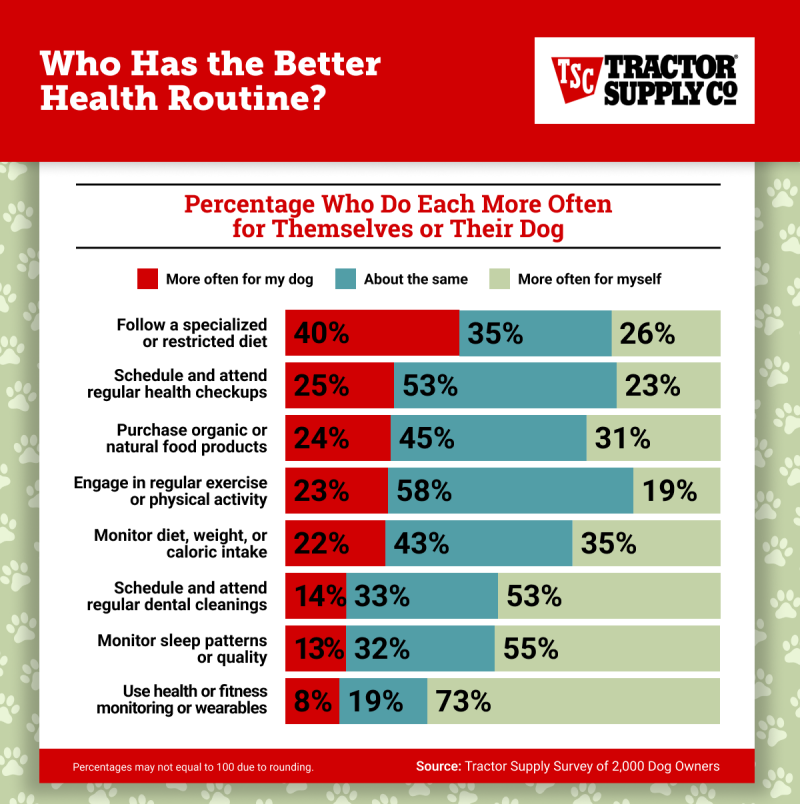
Diet came out as the most dog-prioritized category by a wide margin. Forty percent of dog parents say they follow a more specialized or restricted diet for their dog than they do for themselves, and 24% buy organic or natural food products more often for their dog than for their own kitchen. A quarter of dog parents (25%) also say their dog attends regular health checkups more often than they do.
Technology is one of the few places people still put themselves first. Seventy-three percent of people who use health or fitness tracking use it more for themselves than their dog. Still, wearables have made their way into the doghouse with 27% of dog parents using some health or fitness monitoring for their pet.
* * *
"A common misconception is that if the dog seems okay, they don't need to come in for checkups. There could be something you can't see — there could be a serious illness somewhere, even if the dog isn't showing any signs." - Vet Technician, 22
* * *
Generationally, Gen Z is the most likely to prioritize their dog's diet (41%), exercise (26%), and calorie tracking (25%) over their own. Millennials are the generation most likely to schedule dental cleanings for their dog rather than for themselves (17%). Baby Boomers are the generation most likely to keep closer tabs on their dog's sleep than their own (15%).
* * *
* * *
* * *
## What Is the Difference Between Premium and Regular Dog Food?
[Premium dog food](https://www.tractorsupply.com/a/premium-dog-food) generally uses higher-quality, more clearly sourced ingredients (like a named protein as the first ingredient, fewer fillers, and no artificial preservatives). However, there is no legal or industry-standard definition of 'premium,' though, so the real difference often comes down to which quality signals a buyer trusts.
We asked both dog owners and veterinarians to name their top factors (respondents could choose up to three), and the two groups landed in very different places.
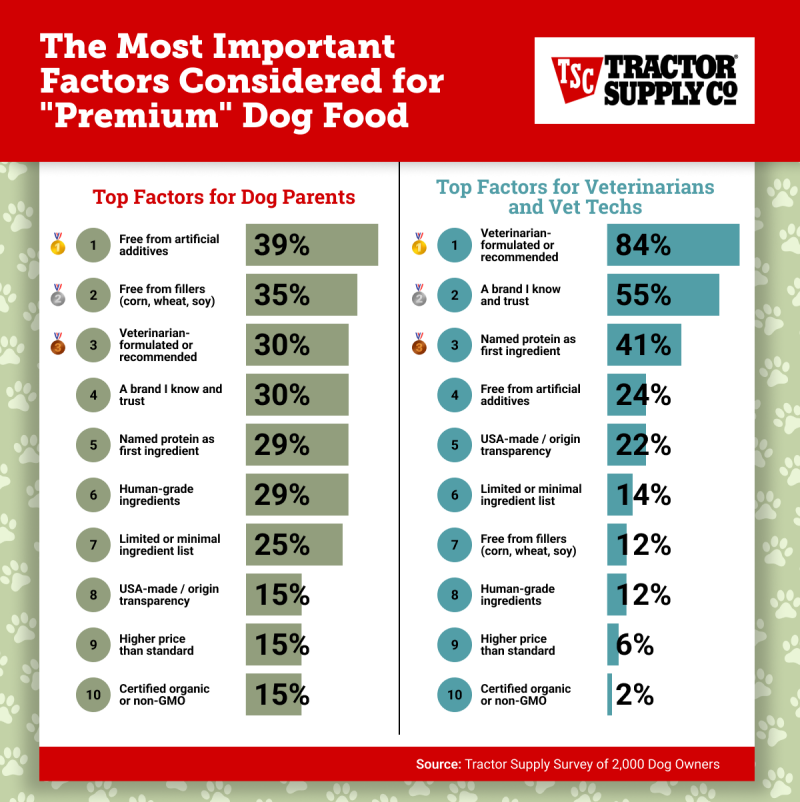
The biggest disconnect by far: veterinarian-formulated or recommended food is the single most important factor for vets (84%), but it ranks just third among dog owners (30%), a 54-point gap.
Instead, owners lean heavily on ingredient-avoidance marketing. "Free from artificial additives" (39% of owners vs. 24% of vets) and "free from fillers like corn, wheat, or soy" (35% vs. 12%) both rank far higher with dog parents than with veterinary professionals. Vets, meanwhile, put more stock in brand trust, with 55% citing "a brand I know and trust" as a top factor, compared to 30% of owners.
Certified organic dog food and natural [dog treats](https://www.tractorsupply.com/tsc/cms/life-out-here/pet/dogs/exploring-trending-dog-foods-and-treats-your-pup-will-love) matter less than you might expect on either side: just 15% of owners and only 2% of vets cite certified organic or non-GMO as a top premium factor, one of the lowest-ranked options in the survey for both groups. Both groups agree on one thing: [fresh frozen ingredients](https://www.tractorsupply.com/tsc/catalog/fresh-frozen-dog-food) matter least, ranking last for owners (9%) and vets (2%) alike.
* * *
"Owners think organic or 'premium' treats are beneficial, even as their dog becomes overweight — they're prioritizing food quality over nutritional balance. I encourage them to give treats infrequently and feed appropriate quantities, not just appropriate ingredients." — Veterinary Nurse/Technician, 21
* * *
That same gap between labeling and substance shows up with brands, too, not just treats.
As one veterinary nurse/technician, 22, put it, "Known brands don't automatically equal quality food. It's always a conversation about ingredients and dietary needs — not just what brand is on the label."
Younger generations appear especially committed to canine wellness. Gen Z is most likely to prioritize food free from artificial preservatives, colors, or flavors (45%). Millennials are more likely than other generations to favor a limited or minimal ingredient list (28%). Gen X looks for a named protein as the first ingredient (33%) more than other generations. Baby Boomers care most about made-in-the-USA or country-of-origin transparency (26%).
### How many ingredients is too many for dog food?
Six ingredients is the tipping point: in our survey of over 2,000 U.S. dog parents, six was the median number of ingredients respondents said a dog food could contain before they would not consider it "premium" or "high-quality."
That number shifts by generation: Gen Z considers seven ingredients the maximum, followed by Millennials at six and both Gen X and Baby Boomers at five.
## How Much Are Dog Parents Really Spending on Food?
We asked dog parents to share how much they spend on dog food each month, including what goes toward premium, fresh, or organic options specifically, and the most they'd be willing to pay if they knew it would make a meaningful difference in their dog's health. The results reveal a real gap between what dog parents spend today and what they're willing to spend if given a good enough reason.
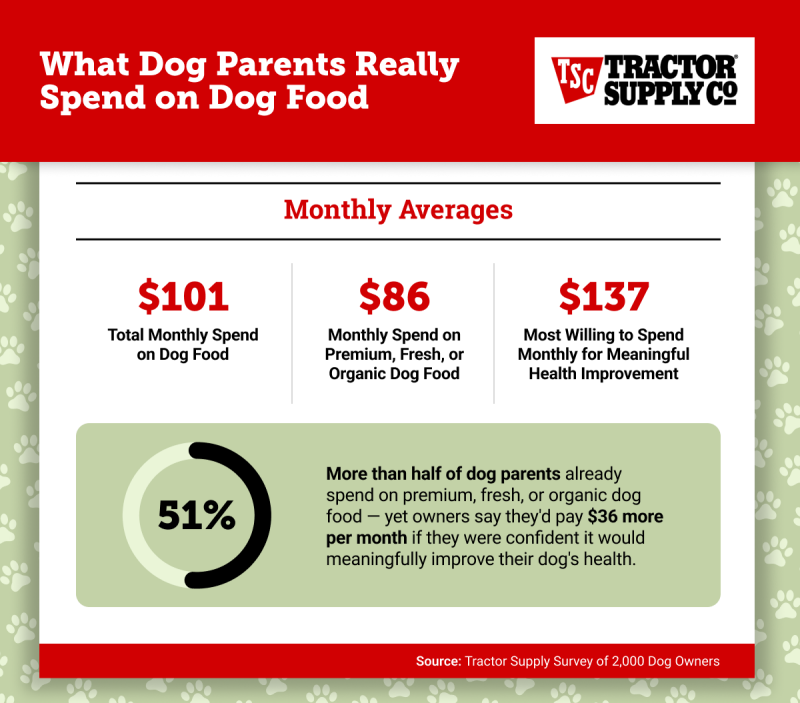
The average dog owner spends $101 a month on food, more than $1,200 a year, with $86 of that going toward premium, fresh, or organic options. More than half of dog parents (51%) already spend on premium food in some form.
But there's clearly room to spend more. Owners say they'd pay a median of $137 a month, $36 more than they spend today, if they were confident it would meaningfully improve their dog's health, about a third more.
That willingness to spend more is strongest among younger generations. Gen Z already spends the most on food overall ($107/month), 24% more than Baby Boomers ($86). But the real gap opens up on willingness to pay: Gen Z would go as high as $148 a month, compared to $110 for Boomers — a $38 spread, nearly double the $21 gap seen in current spending. Younger dog parents are spending more now and are the most willing to spend more if given a reason to.
| Average Monthly Dog Food Spending, by Generation | | | |
|--------------------------------------------------|---------------------|-------------------------------------|--------------------------|
| Generation | Total Monthly Spend | Spend on Premium, Fresh, or Organic | Maximum Willing to Spend |
| Gen Z | $107 | $97 | $148 |
| Millennial | $103 | $86 | $140 |
| Gen X | $98 | $79 | $130 |
| Baby Boomer | $86 | $75 | $110 |
* * *
## The Health Products Vets Recommend (and the Ones Owners Skip)
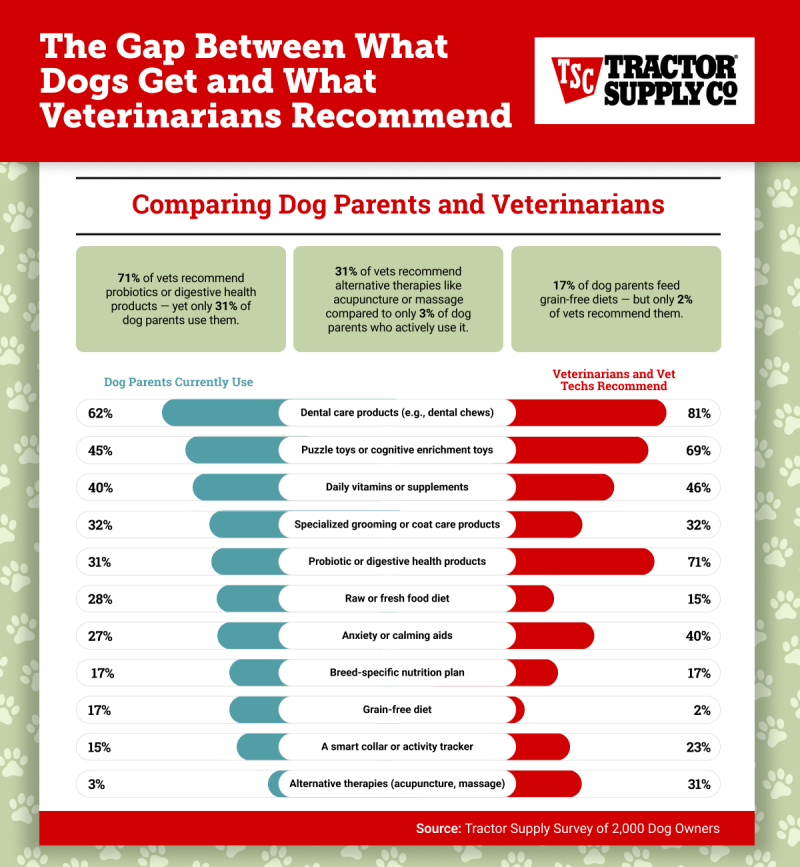
While veterinarians and owners generally agree that preventive care matters, they often disagree on which products dogs actually need. We asked dog parents which health products and services their dog regularly receives, then compared that against the share of veterinarians who say they'd actually recommend each one.
* * *
The biggest gap is in gut health. Vets recommend probiotics or digestive health products for 71% of dogs, but only 31% of owners actually give them, a 40-point shortfall and the largest of any category. Puzzle toys and cognitive enrichment show a similar pattern, recommended by 69% of vets but adopted by only 45% of owners.
The one place owners actually outpace veterinary advice is diet trends. Grain-free diets are used by 17% of owners but recommended by only 2% of vets, and [raw](https://www.tractorsupply.com/a/raw-dog-food) or [fresh diets](https://www.tractorsupply.com/tsc/catalog/fresh-frozen-dog-food) are used by 28% of owners, compared with 15% of vets recommending them. As one veterinary nurse/technician, 30, explained:
A lot of trends in the human health space bleed into the veterinary world. Grain-free may be necessary for people with certain conditions, but it's actually been a detriment to dog health. People think 'human grade' means better — it doesn't always”
* * *
* * *
* * *
* * *
## The Most Health-Obsessed States for Dogs
To find the most health-obsessed dog parents in the country, we built a Health Obsession Score, a composite index of four equally weighted factors based on answers to our survey questions: food premiumization, enrichment product use, pampering, and premium spend share, each normalized to a 0–100 scale.
* * *
### The Top 10 Most Health-Obsessed States for Dog Parents
| State | Rank |
|---------------|------|
| New Jersey | 1 |
| Missouri | 2 |
| California | 3 |
| Massachusetts | 4 |
| Illinois | 5 |
| Washington | 6 |
| Michigan | 7 |
| Maryland | 8 |
| Nevada | 9 |
| Louisiana | 10 |
* * *
New Jersey takes the top spot nationally. New Jersey also ranks among the top states for Pampering (100), Enrichment (99), Food (93), and Premium Spend (97) scores. No single factor drives the win; New Jersey simply excels across the board.
Missouri lands at #2 (93), also without a weak spot, leading the way in Premium Spend (93) and Pampering (90), with Enrichment (88) and Food (87) also well above the national average. California rounds out the top three (92), largely on the strength of spending: California ranked first for Premium Spend, though its Food (79) and Pampering (85) scores are closer to average. Massachusetts (#4, 90) and Illinois (#5, 90) close out the top five, with Massachusetts winning on balance and Illinois standing out for its Enrichment score (98), second only to Washington nationally.
Nationally, dog parents score highest on Pampering (average of 82) and lowest on Premium Spend (average of 74).
* * *
## The Top 3 States in Each Category for the Most Health-Obsessed Dog Parents
| Category | #1 State | #2 State | #3 State |
|---------------|------------|------------|----------|
| Enrichment | Washington | New Jersey | Illinois |
| Pamperedness | New Jersey | Arizona | Florida |
| Food Quality | Nevada | Louisiana | Illinois |
| Premium Spend | California | New Jersey | Missouri |
* * *
New Jersey is the only state to appear in the top three across three of the four sub-scores: Enrichment, Pampering, and Premium Spend. Washington leads the country on Enrichment, Nevada tops the Food category, and California leads on Premium Spend.
* * *
* * *
* * *
## The Most (and Least) Health-Obsessed Dog Breeds
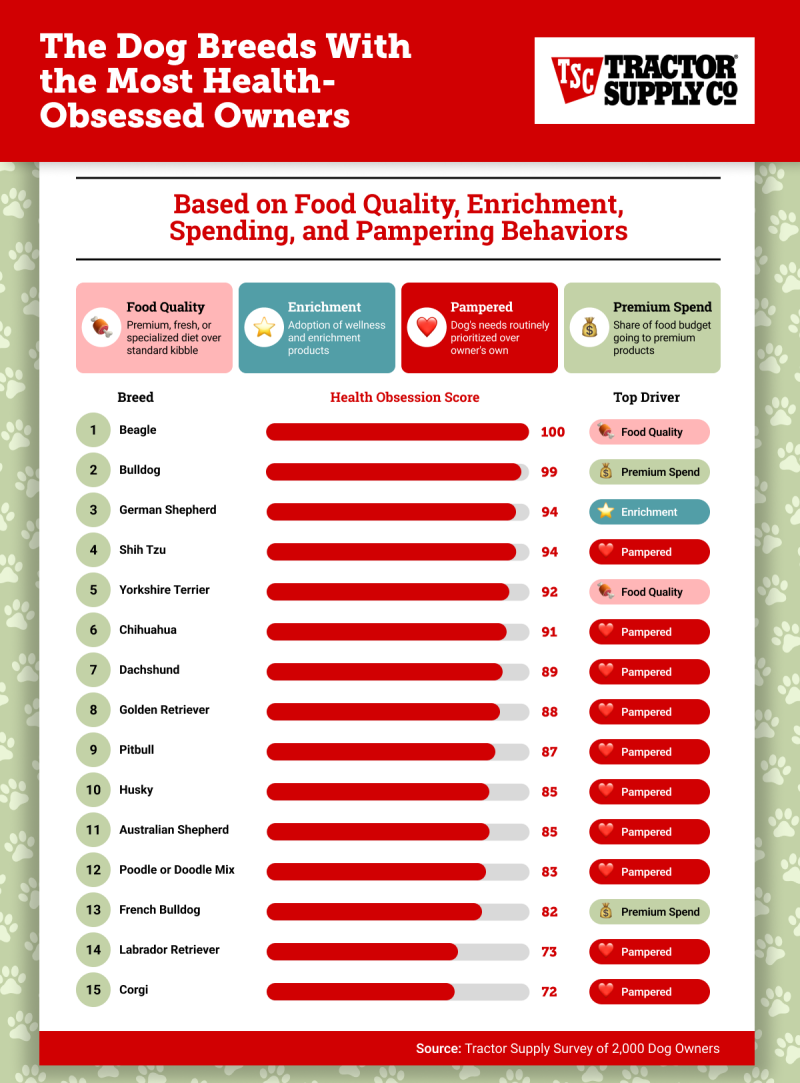
Our survey also examined which breeds have owners most committed to premium nutrition and wellness habits. Using the same four-factor methodology as the state rankings (food quality, enrichment, pampering, and premium spend), we scored the 15 dog breeds with enough survey responses to rank.
* * *
* * *
Beagles and Bulldogs top the breed rankings. Bulldogs' score is driven almost entirely by food spend, the highest of any breed, possibly linked to the breed's known skin and digestive sensitivities, which can often call for higher-quality diets.
Labrador Retrievers, the most common breed in the survey, rank 14th of 15, tied with Corgis at the bottom. The findings don't suggest Labradors receive poorer care, but rather that their owners are less likely to purchase premium food or specialty wellness products than owners of some other breeds.
Small-breed owners out-spoil large-breed owners overall but for different reasons. Small-dog parents put more of their food budget toward premium options. At the same time, large-dog owners are more likely to invest in wellness products like joint supplements, likely reflecting genuine health needs common to larger breeds rather than simple indulgence.
* * *
* * *
* * *
## Conclusion
For most dog parents, taking care of their dog's health is just part of the routine, sometimes even more of a priority than their own. But this data also shows a real gap between what owners look for in dog food and what vets actually recommend. Owners tend to shop based on ingredient-avoidance claims, while vets look for formulation credibility and a track record they trust. Closing that gap starts with choosing food that meets both standards. If you're looking to make a more informed choice for your dog, [Tractor Supply](https://www.tractorsupply.com/tsc/category/pet) carries a range of [premium](https://www.tractorsupply.com/a/premium-dog-food), [fresh-frozen](https://www.tractorsupply.com/tsc/catalog/fresh-frozen-dog-food), and [wet dog food](https://www.tractorsupply.com/tsc/catalog/wet-dog-food) options to help you find what fits your dog's needs.
### Methodology
To explore how Americans care for and indulge their dogs, we surveyed 2,035 U.S. dog owners across all 50 states. Respondents were screened to confirm current dog ownership. At this sample size, results carry a 95% confidence level with a margin of error of approximately ±2%.
To add a professional perspective, we also surveyed 50 U.S. veterinary professionals (veterinarians and veterinary nurses/technicians). At this smaller sample size, the margin of error is approximately ±14%.
As with all survey research, findings are based on self-reported data and may be subject to respondent bias.
### Fair Use Statement
Feel free to share the findings from this study. We ask that Tractor Supply be credited as the source and that any usage include a link back to this page.
Get the top deals, latest trends and more
Sign up for emails from Tractor Supply today.
First Name*
First Name*
Last Name*
Last Name*
Email*
Email*
Sign Up
### Customer Support
- [Order Status](https://www.tractorsupply.com/tsc/orders?orderlookuppage)
- [Return Policy](https://www.tractorsupply.com/tsc/customer-solutions#ProductReturns)
- [Delivery Options](https://www.tractorsupply.com/tsc/customer-solutions#DeliveryOptions)
- [Tax Exemptions](https://www.tractorsupply.com/tsc/cms/policies-information/customer-solutions/tax-exemption)
- [Frequently Asked Questions](https://www.tractorsupply.com/tsc/customer-solutions#CustomerFAQ)
- [Contact Us](https://www.tractorsupply.com/tsc/customer-solutions#contact)
- [Recall Notices](https://www.tractorsupply.com/tsc/cms/policies-information/customer-solutions/recall-notices.html)
- Call:
(877) 718-6750
- [](https://www.tractorsupply.com)
Mon - Sat: 7am - 9pm CT
- [](https://www.tractorsupply.com)
Sun: 8am - 7pm CT
- [](https://www.tractorsupply.com)
Closed Christmas Day
### About Us
- [Who We Are](https://corporate.tractorsupply.com/company-overview/company-profile/default.aspx)
- [Investor Relations](https://ir.tractorsupply.com/CorporateProfile)
- [Stewardship](https://corporate.tractorsupply.com/stewardship/overview/default.aspx)
- [Community](https://ir.tractorsupply.com/Peer)
- [Military Support](https://www.tractorsupply.com/tsc/cms/military)
- [Product Catalog](https://www.tractorsupply.com/a/pt/index)
- [Tractor Supply Stores](https://www.tractorsupply.com/tsc/store-locator)
- [.Pharmacy Verified Website](https://tractorsupply.com/tsc/cms/accreditation)
### Work With Us
- [Careers](https://www.tractorsupply.careers/?utm_source=corpsite&utm_campaign=TSC_Shop&cm_sp=footer-_-tsc%20careers)
- [Sponsorship](https://www.tractorsupply.com/tsc/cms/policies-information/about-tsc/sponsorships)
- [Affiliate Program](https://www.tractorsupply.com/tsc/cms/policies-information/affiliate-program)
- [Potential Vendor Partners](https://www.tractorsupply.com/tsc/cms/policies-information/vendor-information/potential-vendor-partners)
- [Vendor Information](https://www.tractorsupply.com/tsc/cms/policies-information/vendor-information/vendor-center)
- [Tractor Supply Media Network](https://www.tractorsupplymedianetwork.com/)
### Neighbor's Club
- [About](https://www.tractorsupply.com/tsc/cms/neighbors-club)
- [Rewards](https://www.tractorsupply.com/AccountDashboardView?catalogId=10051&langId=&storeId=10151&topNav=nCOfferReward%3Fcm_sp%3Dfooter-_-navigation-_-Neighbors%20Club%20Member)
- [Hometown Heroes](https://www.tractorsupply.com/tsc/myaccount/herobenefits)
- [Frequently Asked Questions](https://www.tractorsupply.com/tsc/cms/neighbors-club-faq)
- [Terms & Conditions](https://www.tractorsupply.com/tsc/cms/neighbors-club-terms-and-conditions)
### Credit Center
- [TSC Credit Card](https://www.tractorsupply.com/tsc/cms/credit)
- [Klarna](https://www.tractorsupply.com/tsc/cms/klarna)
### Stay Connected
Connect & Share with the Tractor Supply Community.
- [](https://www.facebook.com/TractorSupplyCo?cm_sp=footer-_-social%20icons-_-facebook)
- [](https://www.pinterest.com/tractorsupplyco?cm_sp=footer-_-social%20icons-_-pinterest)
- [](https://instagram.com/tractorsupply?cm_sp=footer-_-social%20icons-_-instagram)
- [](https://www.youtube.com/user/TSCTractorSupply?cm_sp=footer-_-social%20icons-_-youtube)
- [](https://www.tiktok.com/@tractorsupply?cm_sp=footer-_-social%20icons-_-tiktok)
### Tractor Supply App
Shop on the go with the Tractor Supply App
[Learn More](https://www.tractorsupply.com/tsc/cms/app.html)
[](https://apps.apple.com/us/app/id1502197298)
[](https://play.google.com/store/apps/details?id=com.consumerapp_v1)
### Stay Connected
Connect & Share with the Tractor Supply Community.
- [](https://www.facebook.com/TractorSupplyCo?cm_sp=footer-_-social%20icons-_-facebook)
- [](https://www.pinterest.com/tractorsupplyco?cm_sp=footer-_-social%20icons-_-pinterest)
- [](https://instagram.com/tractorsupply?cm_sp=footer-_-social%20icons-_-instagram)
- [](https://www.youtube.com/user/TSCTractorSupply?cm_sp=footer-_-social%20icons-_-youtube)
- [](https://www.tiktok.com/@tractorsupply?cm_sp=footer-_-social%20icons-_-tiktok)
### Tractor Supply App
Shop on the go with the Tractor Supply App
[Learn More](https://www.tractorsupply.com/tsc/cms/app.html)
[](https://apps.apple.com/us/app/id1502197298)
[](https://play.google.com/store/apps/details?id=com.consumerapp_v1)
### Customer Support
- [Order Status](https://www.tractorsupply.com/tsc/orders?orderlookuppage)
- [Return Policy](https://www.tractorsupply.com/tsc/customer-solutions#ProductReturns)
- [Delivery Options](https://www.tractorsupply.com/tsc/customer-solutions#DeliveryOptions)
- [Tax Exemptions](https://www.tractorsupply.com/tsc/cms/policies-information/customer-solutions/tax-exemption)
- [Frequently Asked Questions](https://www.tractorsupply.com/tsc/customer-solutions#CustomerFAQ)
- [Contact Us](https://www.tractorsupply.com/tsc/customer-solutions#contact)
- [Recall Notices](https://www.tractorsupply.com/tsc/cms/policies-information/customer-solutions/recall-notices.html)
- [Call:](https://www.tractorsupply.com) [(877) 718-6750](tel:%28877%29%20718-6750)
- [](https://www.tractorsupply.com)
Mon - Sat: 7am - 9pm CT
- [](https://www.tractorsupply.com)
Sun: 8am - 7pm CT
- [](https://www.tractorsupply.com)
Closed Christmas Day
### About Us
- [Who We Are](https://corporate.tractorsupply.com/company-overview/company-profile/default.aspx)
- [Investor Relations](https://ir.tractorsupply.com/CorporateProfile)
- [Stewardship](https://corporate.tractorsupply.com/stewardship/overview/default.aspx)
- [Community](https://ir.tractorsupply.com/Peer)
- [Military Support](https://www.tractorsupply.com/tsc/cms/military)
- [Product Catalog](https://www.tractorsupply.com/a/pt/index)
- [Tractor Supply Stores](https://www.tractorsupply.com/tsc/store-locator)
- [.Pharmacy Verified Website](https://tractorsupply.com/tsc/cms/accreditation)
### Work With Us
- [Careers](https://www.tractorsupply.careers/?utm_source=corpsite&utm_campaign=TSC_Shop&cm_sp=footer-_-tsc%20careers)
- [Sponsorship](https://www.tractorsupply.com/tsc/cms/policies-information/about-tsc/sponsorships)
- [Affiliate Program](https://www.tractorsupply.com/tsc/cms/policies-information/affiliate-program)
- [Potential Vendor Partners](https://www.tractorsupply.com/tsc/cms/policies-information/vendor-information/potential-vendor-partners)
- [Vendor Information](https://www.tractorsupply.com/tsc/cms/policies-information/vendor-information/vendor-center)
- [Tractor Supply Media Network](https://www.tractorsupplymedianetwork.com/)
### Neighbor's Club
- [About](https://www.tractorsupply.com/tsc/cms/neighbors-club)
- [Rewards](https://www.tractorsupply.com/AccountDashboardView?catalogId=10051&langId=&storeId=10151&topNav=nCOfferReward%3Fcm_sp%3Dfooter-_-navigation-_-Neighbors%20Club%20Member)
- [Hometown Heroes](https://www.tractorsupply.com/tsc/myaccount/herobenefits)
- [Frequently Asked Questions](https://www.tractorsupply.com/tsc/cms/neighbors-club-faq)
- [Terms & Conditions](https://www.tractorsupply.com/tsc/cms/neighbors-club-terms-and-conditions)
### Credit Center
- [TSC Credit Card](https://www.tractorsupply.com/tsc/cms/credit)
- [Klarna](https://www.tractorsupply.com/tsc/cms/klarna)
### Stay Connected
Connect & Share with the Tractor Supply Community.
- [](https://www.facebook.com/TractorSupplyCo?cm_sp=footer-_-social%20icons-_-facebook)
- [](https://www.pinterest.com/tractorsupplyco?cm_sp=footer-_-social%20icons-_-pinterest)
- [](https://instagram.com/tractorsupply?cm_sp=footer-_-social%20icons-_-instagram)
- [](https://www.youtube.com/user/TSCTractorSupply?cm_sp=footer-_-social%20icons-_-youtube)
- [](https://www.tiktok.com/@tractorsupply?cm_sp=footer-_-social%20icons-_-tiktok)
### Tractor Supply App
Shop on the go with the Tractor Supply App
[Learn More](https://www.tractorsupply.com/tsc/cms/app.html)
- [](https://apps.apple.com/us/app/id1502197298)
- [](https://play.google.com/store/apps/details?id=com.consumerapp_v1)
- [Privacy policy](https://www.tractorsupply.com/tsc/cms/policies-information/customer-solutions/privacy-policy.html)
- [Your Privacy Choices](#)
- [Terms and Conditions](https://www.tractorsupply.com/tsc/cms/policies-information/customer-solutions/terms-and-conditions-of-use.html)
- [California Transparency Act](https://www.tractorsupply.com/tsc/cms/policies-information/about-tsc/california-transparency-act-of-2010.html)
- [Legal Notices](https://www.tractorsupply.com/tsc/cms/policies-information/customer-solutions/legal-notices.html)
- [Accessibility](https://www.tractorsupply.com/tsc/cms/accessibility.html)
- [Responsible Disclosure Statement](https://www.tractorsupply.com/tsc/cms/policies-information/customer-solutions/responsible-disclosure-statement.html)
- [Surprise (Balance) Medical Billing Disclosure](https://www.tractorsupply.com/tsc/cms/surprise-billing)
- [Transparency in Coverage](https://transparency-in-coverage.uhc.com/?cm_sp=footer-_-navigation-_-transparency%20coverage)
- [Human Rights Policy](https://www.tractorsupply.com/tsc/cms/human-rights-policy)
- [Vendor Code of Conduct](https://www.tractorsupply.com/tsc/cms/vendor-code-of-conduct)
- [California Notice of Collection](https://www.tractorsupply.com/tsc/cms/policies-information/customer-solutions/privacy-policy#_Toc189006423)
- [Privacy Requests](https://privacyportal.tractorsupply.com/)
© 2026, Tractor Supply Co. All Rights Reserved.
ScoutAI
BETA
* * *
Hi there, I’m your AI assistant—here to guide you through our products and answer any questions along the way. How can I help you?
Can you suggest some good lawn mowers ?
What’s the best safe for keeping my firearms secure at home?
What can i feed my puppy ?
* * *
TSC AI is for informational use only. Don’t share sensitive info like SSN or payment details.